web analytics
Categories
bird finding in Costa Rica Birding Costa Rica

Rare Birds Showing in Costa Rica- El Niño

This is the big year for El Niño. The biggest one actually, the major mega release of ocean heat already having huge impacts that will likely worsen. It’s not a good scene, it will likely cause a large degree of suffering and starvation in various parts of the world. The birds are already experiencing the impact and we’re seeing the consequences in Costa Rica.

It began back some months ago with Inca Terns and a few Peruvian Boobies driven from an unusually food depauperate Humboldt Current. I’m not sure where those birds are now; perished or, hopefully finding enough fish in other places. They don’t seem to be in Costa Rica any more. Maybe, but none have been seen.

Instead, we are getting other birds, other signs of foraging problems elsewhere. Here’s some of the rare and unusual El Niño species local birders have found:

White-cheeked Pintail

Last week, a lucky birder spotted one of these handsome ducks at the shorebird hotspot of Punta Morales. This species has turned up in Costa Rica before but it’s always a local mega. Perhaps hailing from the Galapagos Islands, it was foraging and hanging with Blue-winged Teals.

The Cocorocas site at Punta Morales.

Sadly, it seems to have been a one day wonder, perhaps after being chased one too many times by local dogs that were also stressing the roosting shorebirds. Did it move on? It could certainly still be in the area, maybe at any number of less accessible shrimp ponds. On a side note, local birders looking for the duck lucked out with views of rare for Costa Rica White-rumped Sandpiper and American Avocet!

Comb Ducks

Whoah! With only one previous record for Costa Rica, this is a major mega local birders are likely rushing to see at this moment. Found this morning at the Las Pangas Coto 47 hotspot near Ciudad Neily, two females were seen with other ducks in a grassy marsh.

The closest Comb Ducks pertain to a small population in eastern Panama, I suspect that droughts there pushed these choice birds our way. I sure hope they stay long enough for me to see them, they would be a triple whammy lifer/country/year bird!

Red Phalaropes and Sabine’s Gulls from shore

An unprecedented number of Red Phalaropes have been seen from Puntarenas and at coastal shrimp and salt ponds. Although we occasionally see Red-necked Phalaropes from shore, the Reds (or Greys) are pretty uncommon in Costa Rica, even from pelagic boats!

To have several close to shore points to seriously unfavorable conditions where they should be; well offshore and perhaps further south. Joining them are several Sabine’s Gulls. Although not nearly as numerous as the phalaropes, the presence of Sabine’s Gulls near shore has been equally unusual. No doubt, they are here for the same sad, hungry reasons as the sandpiper. What’s next?

A possible Gray Gull!

It looks like a fricking Gray Gull might have been next! Although the photos aren’t great, it sure looks like one was seen at Punta Morales and, given that this is a classic Humboldt bird in a mega El Niño year, it is perhaps unsurprising.

Are there others waiting to be found? Could be, might be one at Puntarenas or in the Gulf of Nicoya right now!

What to watch for?

With the rare birds in mind, it’s time to keep looking for other Humboldt and wetland species. Local birder Tyler Wenzel covered some of these in an article for North American Birds. In addition to the species he mentions and the birds mentioned above, I’d also be aware of these possibilities on the ocean:

  • Higher numbers of Common and Arctic Terns (I probably had a couple distant Arctics on October 24th).
  • Roseate Tern (at least two recently made it onto the Ecuador list!)
  • Kelp Gull
  • Gray-hooded Gull
  • Belcher’s Gull
  • Perhaps Juan Fernandez Petrel and other off pelagic species

And these ones in wetlands, especially in the Las Pangas area:

  • Maguari Stork
  • Whistling Heron
  • Bare-faced Ibis
  • Maybe White-faced Whistling-Duck?
  • Scarlet Ibis on the Caribbean
  • Wandering rails
  • Yellow-billed Tern and Large-billed Tern
  • Drought might also affect flowering and cause hummingbird like Black-breasted Mango, Rufous-crested Coquette and White-bellied Emerald to wander to Costa Rica.

Resident species

When mentioning rare species for Costa Rica, I’m aware that I usually stick to the ones local birders want to see, not necessarily the residents visiting birders are looking for! I suppose that’s because our resident species are always here, go looking in the right places and you might find them. However, I’ll mention that:

Eric Ripma’s Sabrewing Tours group spotted a Black and white Becard at Rio Macho.

Guide Beto Guide found unprecedented Oilbirds at Macaw Lodge.

Black and white Hawk-Eagle was seen in the Boca Tapada area.

Unspotted Saw-whet Owl in the high Talamancas.

Quetzals are in their usual cloud forest haunts at various sites as well as being seen at places a bit lower in elevation (which is typical this time of year).

Umbrellabirds have been seen at Centro Manu, Veragua, and other expected foothill sites.

It’s good to know where these and other birds have been spotted but, it’s always worth remembering they are going to be where their habitat is. Use an up to date bird finding guide for Costa Rica and you’ll know where to look and be in the right place to find them. The birding’s always exciting in Costa Rica, I hope to see you here!

Categories
bird finding in Costa Rica bird migration caribbean slope

Birding Costa Rica in Manzanillo- Tips and Changes

October is migration time in Costa Rica, our May, the month that gets our bino fingers itching and twitching, eyes to the sky, and listening to dark, calm nights. At least I do that, all of the above but also that part about listening to night skies. Usually, I have to wait until 10 and, ideally, have cloudy skies to drive the birds lower. If not, the peeps of Swainson’s Thrushes are too far up there, on the edge of imagination. I think I hear them but they are so quiet and far overhead, I wonder if I had heard something else, a distant fidget of a sound perceived as a Swainson’s peep.

Swainson’s Thrush.

Cloudy skies are another matter, and after 10, when the ambient intrusion of motorcycle engines tapers off, October is when I hear the most birds calling. It’s still quiet but it’s also enough to count Swainson’s Thrushes and project that hearing up into the dark sky to see if I can catch the higher, abrupt call of a Gray-cheeked, the downward slur of a Veery. This year has been largely quiet for night calls but there haven’t been many ideal listening nights either.

There have been several rainy nights, few clouded ampitheaters to hear the birds. Luckily, I was able to catch a few nights with ideal conditions and between occasional bouts of racing cars and sonic attack motorbikes, I enjoyed the audio passage of migrants. One key night, I did manage to hear a Veery and a couple Gray-cheekeds among many a Swainson’s Thrush. That same night, I also heard one or two Upland Sandpipers along with a Summer and Scarlet Tanager.

I’m grateful I had one or two good bouts of evening listening but it seems a far cry from past autumns, even from last year and that brings me to Manzanillo, Costa Rica. In that southern Caribbean migration hotspot, I listened there too, last weekend, during the height of October migration and I found myself wondering, where are the birds?

There were some Swainson’s Thrushes but there should have been hundreds. Last weekend, while birding there during the day, I wondered the same thing. For the time of year and place, there were drastically fewer Swainson’s Thrushes than other years and nary another migrant thrush. Pewees and Red-eyed Vireos were around but there didn’t seem to be as many, nor as many Bay-breasteds as other years (although still fairly common).

There were also fewer Scarlet Tanagers and hardly any Eastern Kingbirds but swallows still poured through, those and a fantastic river of raptors. Were those a few off days? Had the migrants already moved through? Maybe, but aren’t those the same questions us long time birders keep asking ourselves? I fear there are far fewer of some species, perhaps ones that live in boreal forests burned and hammered by human-driven hotter temperatures. I’l have to wait a few weeks to compare migrant numbers with other years in eBird but won’t be surprised if Swainson’s Thrushes are half of what they were from a few years ago.

Regarding Manzanillo, Costa Rica, here are some tips and other changes:

Urbanization means less habitat

Less habitat here.

It wasn’t that long ago that wood-rails trotted on the gravel roads of the village, parrots perched in village trees, and migrants skulked in roadside vegetation. Although we still saw one wood-rail and some other birds, there weren’t near as many as other visits. It was sad to see one wetland in particular, illegally cleared to provide room for a water buffalo. I used to see both small uncommon kingfishers in that wetland, probably not any longer.

More and more lots have also been built on and so, we see fewer birds right in the village. I can’t blame local folks, they are trying to make a living and live somewhere and that land was already put aside for housing but, as with everywhere, people have to decide when and where to draw the line with habitat destruction. At least the village is still surrounded by forest but, to see more birds, you’ll probably need to bird adjacent areas instead of in Manzanillo itself.

Recope Road

Fortunately, one of the best sites is just up the road from Manzanillo. Known as Recope Road, it’s a track that passes through nice mature forest. You can only take a vehicle in for a few hundred meters but, if you felt adventurous, could walk the track further. On our visit, we had a fair number of migrants (mainly REVIs and Bay-breasteds) along with noisy Mealy Parrots and various other resident species. I also whistled in a few fruitcrows but there still seemed to be fewer birds than past visits.

The following day, to see if I could locate certain species and better assess the site, I visited the Recope Road pre-dawn. Two Great Potoos growled but owls seemed oddly silent. Equally quiet was the dawn chorus. It was more like a skeleton cleaning crew whistling in a quiet theater. Where were the woodcreepers? A couple called but not a whole lot else. It’s like so many places, so many formerly rich birding sites in these times of abrupt climate change; there are simply fewer birds.

Paradise Road

This road is another good place to go birding near Manzanillo. One of the few roads to cross and access the coastal hills, it provides views over and into rainforest. Although we only visited one afternoon, it was pretty darn quiet. A few birds made their presence known here and there and although we were fortunate to see Rufous-winged Tanager and at least hear a Sulphur-rumped Tanager (a bird that has largely disappeared from this area), there weren’t a lot of migrants and it was pretty quiet.

It’s still worth birding this spot, especially during the early morning but there’s also more traffic. Taking advantage of the recently graded road surface, several motorcycles and other vehicles drove dangerously fast on Paradise Road. If you bird this site, make sure to park where other vehicles can see and easily avoid your car!

Tourism infrastructure

Keeping pace with visitor popularity, there are plenty of restaurants and accommodation in the southern Caribbean, especially around Puerto Viejo. In Manzanillo, there aren’t very many places to eat but, we found a few good spots. Colores is very good but prices are fairly high (typical for many places these days). A couple sodas near there worked for breakfast, the 4th Generation Restaurant being especially good. They served a fair sized pinto breakfast for a low price and also serve Caribbean specialties for lunch and dinner. I’d go back in a second!

Although we stayed at the friendly Cabinas Manzanillo, most accommodation in the area comes in the form of rental houses, bungalows, and other small places. If visiting on the weekend and high season, various places might lack vacancy. Last weekend was also busy on account of running and cycling events; there were traffic jams near Punta Uva and lines at the wonderful Take it Easy beachside Caribbean food stall (and with good reason, the food is fantastic), and at the DeGustibus bakery.

Other birding sites in the area

It’s worth mentioning that there are additional birding sites in the area that we didn’t have a chance to visit. Cahuita National Park is always good, the Gandoca Reserve has fairly long (if sometimes busy) trails in good rainforest, and the Talamanca Hawkwatch is nice too! There’s also seawatching and nice birding in gardens and habitat around most hotels and accommodation; still worth visiting.

I look forward to getting back to the southern Caribbean, there’s always more to explore, hopefully soon! To learn more about the sites mentioned in this post, support this blog by purchasing my 1000 page ebook, “How to See, Find, and Identify Birds in Costa Rica”. I hope to see you here!

Categories
biodiversity bird finding in Costa Rica Birding Costa Rica

Costa Rica Birding News October, 2026

It’s October 6, do you know where your birds are? I’m talking Red-eyed Vireos, Blackburnian Warblers, Northern Yellow Warblers, wood-pewees, and other species gone from their breeding grounds. I know where some of them are. I’ve been watching them in Heredia, Costa Rica, mostly in a precious patch of green space.

There have been dozens of Blackburnians flashing varying degrees of black-striped pumpkin orange. Many sally like mini-flycatchers, going full on acrobatic to catch bugs and busy the foliage. Northern Yellow Warblers have been doing some of that too, there’s usually 3 or 4 around, most seem to be drab yellowish females or juveniles.

Although REVIs are still around, it seems like most have passed through. At least I’ve been seeing less over the past few days. In September, a dozen or more would play hide and seek in the neighborhood, mostly doing the hide part. Silent and wearing natural leaf-like plumage, they have been the definition of unobtrusive.

On account of their foraging necessity, pewees have been more obvious. Perching on small dead snags or other suitable spots to watch for bugs, I’ve seen two or three most mornings. The majority are Easterns but there have been a few Westerns as well along with Empids that usually stick to the vegetation. Those smaller flycatchers have come in the form of Willow, an Alder or two, and Yellow-bellied.

There have been a good variety of other birds, a small wave of Common Nighthawks, Canada Warblers, American Redstarts, and other migrants including gnatcatcherish Chestnut-sided Warblers here for the winter duration. They’ve been joined by our first Baltimore Orioles and Summer Tanagers, and Golden-wingeds should appear any day now.

These migrants, birds that summered in the boreal and mixed forests of Canada and the USA have been sharing space with Brown Jays, Melodious Blackbirds, Blue-gray Tanagers, kiskadees and other birds while Crimson-fronted Parakeets screech overhead. They have to watch out for the Short-tailed Hawks that call high over the houses at sunny 9 a.m., and avoid the occasional Ferruginous Pygmy-Owl (I saw one with a Northern Yellow Warbler in its talons). In more forested areas, some of those migrants are flocking with antwrens, woodcreepers, and glittering tanagers as they evade Barred Forest-Falcons and Tiny Hawks.

birding Costa Rica
A Tiny Hawk might be the same size as an American Robin but it’s a rough, metal bird.

Such is early October in Costa Rica, here’s what else a birder can expect.

Slaty Finches in the Talamancas

One of the more difficult resident species has been entertaining local birders in the high, cold Talamancas. The Slaty Finch is one of those birds that appears in the field guide but typically stays elusive. Despite the “finch” part of its name, this challenging bird is actually a tanager, one that may move around in search of seeding bamboo. Or, it just wanders around. Or, it is a low density species that doesn’t typically sing its super high pitched song unless it finds seeding bamboo.

No one really knows because this lead-colored bird is nearly impossible to study. However, one thing we do know is that it can visit seed feeders, at least on occasion and maybe seasonally?

Lately, some have been showing at Suenos Natura Birds Sanctuary along with Peg-billed Finches! Although this took place in September, they could still be around that area and might even become regular visitors. Small groups have also been seen in the Dota Valley, perhaps October is a good time of year to lay eyes on this elusive bird.

Interesting Seabirds at Puntarenas

Heading down to the coast, Puntarenas seabirding has been especially good of late. Over the past few days, local expert guide Beto Guido found a number of Red Phalaropes, Arctic Tern, and other birds rather close to the cruise ship dock. This time of year tends to be better for pelagic species near Puntarenas but Red Phalarope is especially noteworthy for Costa Rica. The presence of Arctic Tern at the Puntarenas tip and near Jaco may be an indication of additional pelagic species foraging closer to shore on account of the current El Nino.

Today would be a good day to watch from the point or take the ferry, who knows what might fly by?

Major Migration Wave in Costa Rica

Migration has been good but the peak takes place during the month of pumpkin spice. The next two weeks should be especially good with a blend of earlier migrants and the late-comers like Bay-breasted Warblers, buntings, and Rose-breasted Grosbeaks.

With luck, a birder in Costa Rica these days could also see migrant cuckoos, Veery, and Gray-cheeked Thrush among other species. At The Nest, a fantastic birding oasis owned by the folks at Lifer Tours, they’ve had both cuckoos, several Ceruleans (when they passed through in August), and many other species. I wonder what else they\ll turn up? Perhaps a skulky ground warbler named after a state that starts with a “C”?

At my place, I’ve had a couple good nights of nocturnal bird movements, I’m hoping I’ll get a few more. The first and best night was an evening quietly punctuated by the peeperish calls of Swainson’s Thrushes, Dickcissels and one or two Upland Sandpipers. Any day now, weather permitting, I should also hear Veery and Gray-cheeked Thrush. I hope so because I might not see them on the ground. That’s how it’s been on other nights with lots of calling thrushes; many heard and none seen the following morning!

Down on the Caribbean slope, the hawk counters have already been tallying hundreds of birds in the annual river of raptors. The majority should start pushing through any day now; thousands of Broad-winged and Swanson’s Hawks and Turkey Vultures with lesser numbers of other species.

October Global Big Day at the Refugio Lapa Verde

Coinciding with migration and hawk counting, on October 10th, the Refugio Lapa Verde is hosting an open house/raptor festival event. I suspect it will be like the previous year’s birding shindig, one full of birds, flying raptors, local vendors and overall good birding times.

If you will be in Sarapiqui, Costa Rica on October 10th, visiting would certainly be worth your while. You may find more information at their Facebook page.

In other parts of the country, although there hasn’t been much chatter about it, we should see local birders in most corners of Costa Rica. I know I’ll be out there, not sure where yet but birding somewhere in this land of quetzals, tanagers, hummingbirds, and 100s of other bird species.

October Weather, 2026

But what about the weather? Is it going to rain? Be windy or birding under a blazing sun? No matter where you go birding in Costa Rica, I’d stick to the shade as much as possible. As for October weather, in Costa Rica, it’s always hit or miss. Towards this tail end of the rainy season, we can experience heavy rains or sunny weather or a blend of the two.

This year, with El Nino throwing a wrench into those expectations, who knows what might happen? Lately, we’ve had typical rain season weather of sunny mornings and rain in the afternoons, especially on the southern Pacific slope. Although there have been expected sunny days on the Caribbean side, there have also been heavier rains than usual (as is expected for El Nino weather). For what it’s worth, the forecast for the rest of the month predicts typical rain season weather for the rest of this week and then drier weather later in the month.

In terms of birding, that means being prepared for rain and getting in as much of your birding as possible during the early morning. It also means that if you get light rain or on and off rain in the afternoon, you can also experience good bird activity and a better chance of raptors perched in the open.

Interesting Owl Observations

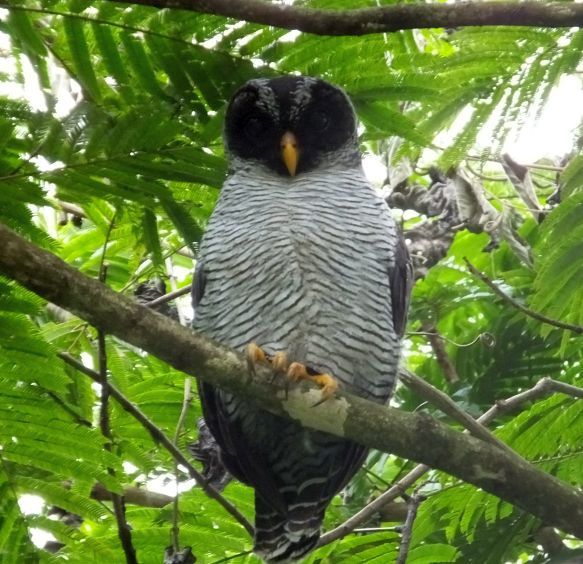
black-and-white-owl

On the local bird front, lately, there have been some interesting owl reports. Last month, more owl species were calling in some areas than expected, perhaps on account of odd, drier weather than usual.

Black and white Owls continue to be seen at high elevations and we can say the same for Spectacled Owl. Historically, these big owl species were largely found below 5,000 feet in elevation. That started changing some years ago, maybe around the same time toucans and other species began to move upslope, no doubt in response to warmer, climate-changed induced weather.

How do those large owls affect highland ecosystems? Do they impact smaller owl species that didn’t typically occur with them? There haven’t been any studies looking into this but I bet they do. In any case, don’t be surprised to run into either of these big owls at high elevations.

The other bit of owl news is quite the mystery! Recently, a local birder reported the undescribed Puntarenas Screech Owl from cloud forest at Villablanca near San Ramon. There’s a picture and recording and although it may sound slightly different, it sure sounds close enough to be the undescribed taxon and not a Middle American Screech-Owl. Villablanca being so far from the southern Pacific zone, just what the heck is going on here!?

"Choco" Screech-Owl

Well, to add more intrigue, this isn’t the first time Puntarenas type calls have been heard in northern Costa Rica. It or something very similar has also been recorded at sites in the northern volcanoes. Although this might seem bonkers, when we look at ranges of couple other “South Pacific” bird species, finding this species in these areas might not be as outrageous as it first appears.

A classic South Pacific endemic, the Black-hooded Antshrike, also occurs at spots in Guanacaste and the northern volcanoes while Scaly-breasted Wren, and maybe a few other species also range to near San Ramon. These birds occur in a narrow band of humid forest or, patches of humid forest that locally occurs in the foothill zone of the Pacific slope. Much of it is deforested and areas that remain are little birded, maybe it’s no surprise that an undescribed owl taxon has been overlooked for that area?

When we throw climate change into the mix, that could further explain why this species has moved upslope and into the Villablanca cloud forest. The sighting is also impetus to search for it in more spots, especially any humid foothill forest on the Pacific slope.

That’s all for now but I’ll just mention that the wonderful resident birds are in their usual spots and the birding in Costa Rica is great as always. To learn more about birding sites mentioned in this post, please support this blog by getting my updated, 1,000 page ebook, “How to See, Find, and Identify Birds in Costa Rica”. I hope to see you here!