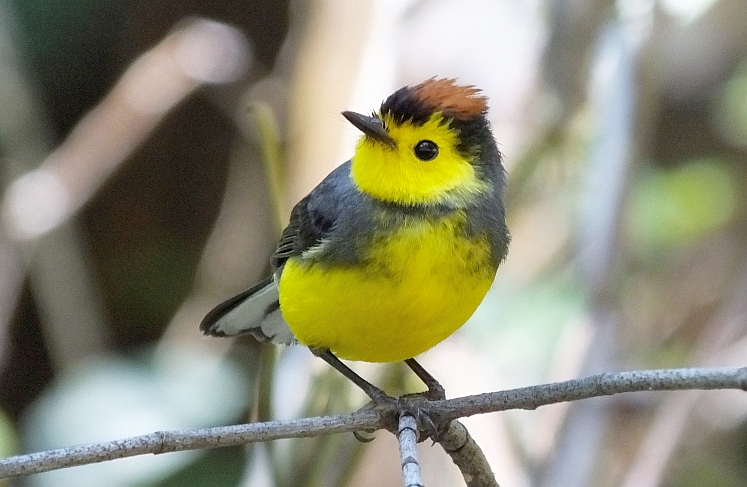
In Costa Rica, the birding deal is always fantastic. Drive an hour and you could feasibly lay eyes on a quetzal, the one and only Wrenthrush, Scarlet Macaws, antbirds, a dozen hummingbirds, and more. I mean, honestly, that’s pretty darn good.
Take this morning for example. In my urbanized, very much people-centric neighborhood in Heredia, I walked down the street, birded for an hour and saw 39 species, one of which was a Ferruginous Pygmy-Owl with an unlucky Northern Yellow Warbler in its talons (!). It was being harassed by a couple Brown Jays, a bunch of beautiful Blue-gray Tanagers, hummingbirds, Common Tody-Flycatcher, Tropical Mockingbirds, a Yellow-green Vireo, and other species while South American-bound Barn, Bank, and Cliff Swallows and occasional screeching Crimson-fronted Parakeets graced the skies.
Those birds and more can be attributed to lifesaving big trees and vegetation on a small adjacent farm as well as a riparian zone. It’s not much habitat and yet, it still act as vital living space for a bunch of birds and migrants (I recently saw 3 to 4 Cerulean Warblers there and will likely see a Golden-winged soon). It’s wonderful but the best birding is, of course, further afield. Regarding that, much to our good birding fortune, as I alluded to above, you don’t need to go far to see a wealth of incredible birds.
With that in mind, I’ve designed some short birding tours that maximize birding potential in different major habitats, close to the greater San Jose area. More than 100 species are possible on all of them, 200 even possible on the two night trips. Check it out:
One Night Birding Tour in the Costa Rica Highlands
A male quetzal is always the star of the avian show.
Who says you have to go birding for a week to see a quetzal in Costa Rica? Although 7 days birding is always better than one or two, if you don’t have the time for it, fantastic birding near San Jose is possible in a morning, day, or one night trip.
3 other of many stand out bird species possible on this tour include:
The cloud forest highlands are some of the closest quality birding habitats to San Jose but, you only need to go a little bit further to reach another, completely different biome on the Caribbean slope. These foothill rainforest and lowland rainforest host the highest variety of bird species in Costa Rica; day trips I have guided there have resulted in 150 to 170 species. Imagine how many birds are possible during two and a half days of birding?
Three stand outs of many possible species include:
Two Night Birding Tour in a Mega Birding Hotspot- the Pacific Lowlands
To reach the close highlands and Caribbean rainforests, we drive north. Go in the other direction and it only takes 45 minutes to an hour to reach Scarlet Macaws!
These and hundreds of other species live in the mega ecotone of Carara and Tarcoles. In this river valley, coastal habitats, rainforest and dry forest meet and offer a fantastic array of birds. The following are three of a huge number of avian possibilities:
Great TinamouMale Slaty-tailed Trogon.Rufous-tailed Jacamar
This two night birding tour to the Carara area is a good way to see an excellent blend of dry forest, edge, and humid forest endemics in a short amount of time.
Have an extra day or two in the San Jose area? If you are in San Jose for business or starting and ending a birding tour, these itineraries will enrich and expand your birding experience in Costa Rica. They can also be done as one night tours or even as a day trip. Prepare for your trip with my Costa Rica birding site ebook and study your field guides, there’s a lot of birds waiting for you in Costa Rica!
Bird migration is not one fine day when all the birds decide to leave, as if on schedule, catching a flight. Although they do follow a good degree of evolution honed timing, different types of birds use different cues to get up into the sky and go.
Shorebirds, those incredible fliers, reach the evergrass and marshy habitats of the Arctic, look around for a bit and, if the breeding deal isn’t to their liking, turn around and start to head back south. That would be heading all the way to Virginia estuaries and Texas mud flats and onward, some even reaching Patagonia.
Check a map and that looks a bit exaggerated, flippant, loco. Except that birds can’t afford to be fools. Make the wrong choice, bad place to land, wrong time to fly, don’t eat enough, and it’s a Darwinian dead end. No, some shorebirds leave the Arctic early because cues tell them it’s not worth sticking around and trying to breed. Not worth the energy, better to use those sharp wings to zip it back down to the tropical mud flats, the muddy estuaries sieved by spoonbills and haunted by crocodiles.
In Costa Rica, we’ve seen potential signs of that monkish choice this past summer; Hudsonian Whimbrels and other shorebirds in June. Some were probably young birds that purposely overstayed their winter vacation but maybe not others. There seemed to be a few too many that came back early to have all been youngsters extending their tropical mudflat party.
Since then, numbers of shorebirds have been passing through the country but, for the most part, we’ve been waiting on a lot of the other birds. Yes, there have been the expected Least and Elegant Terns, and I was dealt a fortunate August card with Sabine’s Gulls and the swallows started flying a month ago. I’d be amiss if I didn’t also mention the expected pulse of Swallow-tailed and Mississippi Kites, our “early” raptors, but the bigger numbers and bird variety didn’t start happening until recent days, yesterday and today most of all.
For the past week, I glance into the morning sky over the traffic laden streets of San Joaquin de Heredia and I see small birds flapping and soaring, flying steadily east and south. Groups of six, then ten, then another ebb in the flow of Cliff Swallows over houses and busy corners. On one such corner, as with many a corner these days in urban Costa Rica, a Venezuelan mother sells lollipops for coins, for something to help support her two young children with her. The kids might be sitting on the sidewalk, might be playing on a street sign as hundreds of vehicles pass by. Some do give her something and she smiles, dozens of Cliff Swallows flying over ignored or unseen, they’ll probably fly over the same jungles of the Darien that she and her kids likely crossed going the other way.
The past few days have seen more swallows, more Cliffs and Barns and, this morning I had a few Banks too, all taking that same ancient route to South America. And now their skies are joined by other birds, mostly ones moving through the sheltered dark of night. I peer into the night sky and can’t see them, haven’t heard any but, this morning I had proof of their passing.
It had rained most of last night, a rare occurrence during these Super El Nino days. Normally, it would be raining here every night, long, heavy rains but, the overheated waters in the Pacific have turned this place into a temporary dry season. It feels like January; sun and wind with rain clouds gripping the mountains and flooding some parts of the Caribbean lowlands. But last night, we had a good, solid rain, this morning was cloudy and cool and bereft of breeze.
That’s good birding weather here, weather conducive to good bird activity and yes, it was. I walked the quiet roads in my Central Valley neighborhood, took a short stroll down the street to the wall that separates us from an adjacent rare and much appreciated farm. As usual, I scanned the massive remnant fig on the other side of the wall, a tree that, over its hundred or more years must have fed countless thousands of birds; everything from kiskadees to flocks of Amazonian bound Eastern Kingbirds, warblers, parrots, and Three-wattled Bellbirds too.
Birds still stop in it, maybe some of the same ones year after year but today, I couldn’t find anything in the thick jade leaves. Closer though, hummingbirds were sputtering and chasing each other, de-facto Rufous-taileds mostly but one on a high perch was a female Green-breasted Mango.
Another that flew to a different tree ended up being a Plain-capped Starthroat, needle beak and all!
Common birds were also calling and an Inca Dove splashed in a mini pot hole bath but I didn’t see much else. I thought, “Where’s the Red-eyed Vireos? Where’s the warblers?” Sans expectations, I strolled onwards, heading another two blocks to the water treatment area. This is our main patch of green space, our one and only occasionally smelly and slightly noisy oasis (classic birding spot), it flanks a riparian zone where cecropias, figs, and other trees grow and it’s of course where most of the birds are.
Look close and careful and you might see a Lesson’s Motmot or glimpse the Common Tody-Flycatchers and Cabanis’s Wrens that usually call from the foliage. Keep watching and more birds appear, especially in cloudy weather and, apparently, especially during the first week of September.
Peering in and beneath the trees, I glimpsed a dim flash of yellow that became a Northern Yellow Warbler. Another joined it and then there was a smart black and white bird creeping on crooked tropical branches. It’s always nice to see Black and white Warblers, so distinctive, so cool looking, just like that initial one was on the corrugated bark of a big tree at Hyde Park in Niagara Falls, 1981. I wasn’t hearing much but I kept looking, I know how sneaky these migrant birds can be when they pass through Costa Rica.
Sure enough, a bit of a paleish bird zipped into the green. Then another and another. Scanning eventually found them; Red-eyed Vireos roosting and resting I suppose. I eventually saw others foraging and more flying in and out of the vegetation; all silent, all so unobtrusive, I must have seen a dozen and figure that the parks and remnant precious green spaces in the Central Valley must host hundreds of the hidden birds.
I kept watching and a small pale bird moved in a Cecropia. I was immediately on it with my bins and yes, maybe because of its pale color or other subtle subconscious hints, it was a bird I had suspected it to be; Cerulean Warbler! Gem blue and cloud white, it busily inspected the thick Cecropia foliage before joining the Yellow Warblers in thicker, more tangled cover.
Feeling grateful and elated, I figured I’d better watch some more, see if I could lucky with an ultra sly cuckoo or maybe a less common warbler. There were also nice resident species to watch; a pair of Lineated Woodpeckers flapping into view, beautiful Hoffmann’s Woodpeckers too and the common kiskadee trio (Great Kiskadee, Boat-billed, and Social Flycatchers). Blue-gray Tanagers also sort of got into the way and a Black Phoebe perched and called behind me.
It was some nice birdiness and then it got bird crazy! Out of nowhere, as I visually checked the foliage for hints of movement and out of place shapes, a dark bird with pointed wings flies right in front of my field of view, eye level. It swoops around in a circle and then cuts off to the other side of the trees. I find myself saying out loud, “Common Nighthawk!”
I don’t know if I flushed it or if the nighthawk had suddenly flown in but I was pretty happy to see it. Although these summer time nightjars pass through the Central Valley, the numbers are small and who knows how many fly over unseen, up in those dark skies? To see them for the year, I usually have to go to the Caribbean lowlands or coast, it was fantastic to see one this morning, and at such close range.
Not long after the nighthawk had bird bombed my vireo searching, the sun came out and a breeze picked up. As expected, the already subtle migrant bird activity quickly died down and I started walking back home. On the way, in the view over houses to a distant McDonalds, churches, and the airport, I saw a slender bird in flight and there the nighthawk was again. Assuming it was the same individual, it hadn’t gone to roost, there it was, boldly and quickly covering ground as it flew over the houses. I hope it found a good roost, I hope it’s somewhere much further south tonight as it flaps and glides towards Brazil.
I had a good morning but, checking eBird lists, I wasn’t the only one. A birder reported 100 Common Nighthawks on the coast, and my friends Juan Diego and Maria Jose of Lifer Tours had some yesterday and today at The Nest along with several Ceruleans, Prothonotary Warbler, and other migrants.
Over by Naranjo, Jim Zook had a rare Yellow-throated Warbler along with other migrants, and one of the Garrigues sons (of Richard Garrigues, author of the Birds of Costa Rica a Field Guide) had a dozen Upland Sandpipers (!) at the airport as well as various migrants near there.
Yes, the pace of bird migration in Costa Rica has definitely kicked up a notch, what will tomorrow bring?
Want accurate and updated information on where to go birding in Costa Rica? Where to see Snowcap and how to see quetzals and 900 other species of birds? Please consider supporting this blog by purchasing my 1,000 page ebook “How to See, Find, and Identify Birds in Costa Rica”. Recently updated, it will enhance every birding trip to Costa Rica. I hope to see you here!
We have arrived to September, year of the Super El Nino (2026) and here in Costa Rica, the weather has lived up to the meteorological predictions; heavy, flooding, landsliding rains where it should be drier, and very little rain where it should be awash with precipitation. It’s like someone flipped a tripswitch to push the Pacific rains over to the Caribbean, and that someone in question is the Pacific Ocean. Way too warm, something’s gotta give, something already gave and it’s gonna keep on giving, the weather sages say into 2027.
It’s a flipped deal from the expected, one that makes me wonder how it’ll affect the local avian scene.
In Costa Rica, lots of birds take advantage of the wet season to raise young, especially on the Pacific slope and Central Valley. The same goes for the Caribbean slope but it’s much more pronounced on the west side of the mountains. Evolution has keyed the birds into this rain regimen for thousands of years; nest when the rains start, higher productivity means more food and a better chance at raising broods. It’s why the Yellow-green Vireos show up in spring en masse, singing from every park and foliaged area of green space on the Pacific side.
Sulphur-bellied Flycatchers come here for the wet season too.
Swallow-tailed Kites are another species that arrives for the rains, perhaps in part, benefitting by depredating nests that resident species build. But what happens if the rains don’t arrive like they should? What happens if it rains early and goes back to a pseudo dry season deal replete with moisture wicking winds and hour after hour of the natural sun lamp beating down from the blue?
The same goes for Piratic Flycatchers, the latter here to commandeer the bird nests other species are building so they can raise young of their own (!).
How’s that for some weird cuckooish bird vagabond activity? If fewer birds nested, the naturally “lazy” Piratics must have had fewer broods but, it looks like a fair number of birds successfully nested after all. I doubt as many as normal but, I do know quite a few seemed to nest early. Like, they got the memo, knew something we didn’t- unsurprising for birds far more in cue with the happenings of their natural surroundings than most people are.
Back in February, it seemed like the early rains triggered a nesting response; hopefully those species succeeded in raising young. I can’t imagine many birds nesting later on did as well.
With migration kicking into gear, I can’t help but likewise wonder if the change in rainfall affects food availability for migrants. I would think so for the Pacific slope but maybe those birds that land on the dry side of the mountains can somehow move over to the wetter side? I hope so and it’s not out of the question, those wetter forests are pretty close. In the meantime, at least it has been raining a bit more on the Pacific, hopefully that trend will continue to give resident and migrants birds some respite. Here’s some other news from Costa Rica:
Umbrellabirds at Centro Manu and a Way to Help this Endangered Species
The Bare-necked Umbrellabirds are back at Centro Manu! Although these crow-sized megas aren’t exactly abundant, at least you can know that a few are frequenting the forests of Centro Manu. In keeping with the timing of their elevational migrations, there are probably more in nearby, similar areas but Centro Manu is one of the most accessible spots.
Once in a while, one shows up right around the cabins or parking area but usually, you need to hike into the back part of the forest to see them. That means wearing rubber boots and being careful because it’s a wet, muddy trail with roots and other slippery factors but, if you can handle that and hang out in the back part long enough, you have a fair chance of seeing this special bird.
You’ll see lots of other good birds too, maybe Snowcap, manakins and more. This spot is possible as a day trip from the La Selva and San Jose area, if interested in a guided day trip, contact me at information@birdingcraft.com
A few of my eBird lists from guiding clients at Centro Manu:
One of the main reasons it’s so hard to see Bare-necked Umbrellabird is because the big cotinga is endangered. Their populations need more foothill and adjacent lowland rainforest than is available, about all we can do is reforest as much as possible. That and support this organization: the aptly name Umbrellabird Conservation Action Network (UCAN). This NGO has been doing more to help this rare species than anyone, check out their site and please consider lending your support. They have some great inside information about umbrellabirds in Costa Rica and can also arrange an ethical visit to the only known lek!
Migrants Have Arrived in Costa Rica
What I mean to say is that the first wave of songbird migrants has arrived. It seemed to happen on August 31th, after a couple days of rainy weather. I had been checking the tiny areas of green space in my urban Central Valley neighborhood for some days before then but had few birds. One day, there was a movement of swallows including a locally uncommon Purple Martin (most move through the Caribbean lowlands) and one or two Red-eyed Vireos but nothing else.
That changed this past Monday when my morning walk revealed several migrants foraging in a small riparian zone. I hadn’t expected them, before reaching that spot, I hadn’t seen any pewees nor any other migrants. However as I approached the streamside vegetation, I heard a chip and saw a small flash of yellow. The first Northern Yellow Warbler of fall migration! Then I saw a second and wondered if there might be another bird or two around.
Waiting by the mix of tall trees and low, thick vegetation, I began to notice some movement in the leaves and saw a small bird zip by. Oh yes, some birds were there alright! Most turned out to be Red-eyed Vireos but there was also an American Redstart and, when two small warblers flipped into view, I quickly realized i hit the jackpot with close views of female Cerulean Warblers! I had hoped to connect with that bird, knew that they were moving through but seeing them in the Central Valley is always hit or miss. Luckily, that morning, I was in the right place and enjoyed watching them forage down low for some time. I suspect three were actually present but can’t say for sure.
I took that as a cue to stay put and keep watching and although no cuckoos popped into my field of view, I did see quite a few REVIs, one Blackburnian, and a Sulphur-bellied Flycatcher along with Cliff Swallows flying overhead and three more Purple Martins. More birds should be on the way with each coming day.
Puntarenas Birding Pays Off
The port of Puntarenas is off the regular beaten birding track but, go with a scope and seawatching often pays off. On Sunday, we took a morning trip there and even though the warmer than usual waters looked like they had a bit of a red tide going on, I still saw birds.
It was a bit weird but I guess that’s normal for less than normal conditions. There weren’t as many pelicans nor frigatebirds as I usually see, nor as many Royal Terns but, some other birds were passing by. I had hoped to catch Least Terns as they pass through Costa Rica and, sure enough, it didn’t take long to see some flying towards the inner gulf. Over the course of an hour and a half, I might have had a dozen along with a scattering of Black Terns, and some Elegant Terns too.
Most were fairly far out but, as is typical for this spot, several flew in from the sea to fly fairly close to the point. I could see a feeding flock way out on the horizon, looked like most birds were in the outer gulf but, I also picked up a not so common, Common Tern, had one of each of Cocos Booby and Blue-footed Booby and, as I was on the verge of leaving, noticed the best bird of the day.
It’s hard t leave Puntarenas because birds can occur at any time, flying in off the ocean. Sunday was no exception as my last binocular scan picked up a pale bird that looked slightly different. I put the scope on it and was pretty sure it had flashing black and white wings. After some playing with the zoom, I was able to follow it long enough to know I was seeing two Sabine’s Gulls!
Although this high Arctic species is regular in pelagic waters, you have to be lucky to find them from shore, even in the Gulf of Nicoya. Even better, one of those same birds or another one ended up flying rather close to the point. It was a pleasure to get such good views of this beautifully patterned gull, one normally associated with ice, eternal summer days, and the high seas.
Book Rooms Now for the High Season
On the future birding front, just a reminder to book your stay in Costa Rica now before it’s too late. For a lot of the most visited places, it might be too late already, don’t wait any longer. If you can’t stay at a preferred lodge, at least there’s other options along with a plethora of excellent birding sites to choose from.
“How to See, Find, and Identify Birds in Costa Rica” 2026 is Available!
Speaking of those birding sites, you’ll find nearly 300 of them in my bird finding guide for Costa Rica. Recently updated for 2026, here’s some reasons why this 1,000 page ebook will enrich any birding trip to Costa Rica:
-Unlike a recent AI “written” itinerary guide I’ve seen, my ebook wasn’t crafted from random and erroneous information online.
-I wrote it based on decades of experience and studying birds in the field, and what I’d like to see in a bird finding guide including accurate information that stems from firsthand knowledge.
-Updated and edited accounts for nearly 300 sites, many of which aren’t on eBird. However, there are also links to eBird hotspots.
-Tips and ideas to help you find unfamiliar birds like puffbirds, tinamous, and antthrushes along with information about and honest chances at the rarest species in Costa Rica.
-Identification tips for woodcreepers and everything else.
Not to mention, purchasing this book also helps support this blog.
Birding Apps and Field Guides to Enrich the Upcoming High Season
A field guide is another essential for any upcoming birding trip to Costa Rica. Yes, you could get the free Merlin app and that’s great (although it’s vocalization ID is still limited for Costa Rica) but, there are other publications with more in depth information written by local birding experts.
The main app to get is the Costa Rica Birds Field Guide app by Birding Field Guides. This digital field guide includes:
-All the birds on the Costa Rica list and a bunch more that could turn up (more than 1,000 species total).
-Many images for most species including birds in flight and others to help with identification.
-Vocalizations for most species.
-Field maps and detailed information including tips for seeing each species in Costa Rica.
-Information about habitats, regions, and other aspects of Costa Rica.
-Free updates and works offline.
-Can be customized to show target birds, birds from certain regions, habitats, family, and more.
As far as field guide books go, come October, you’ll also want to get the new edition of the Garrigues and Dean “The Birds of Costa Rica: A Field Guide“. Having seen some of the new illustrations and other features, I can’t wait to get this book! From what I’ve seen, it promises to be a must have field guide and addition to every birder’s library. I know how much they’ve been diligently working on this book, it’s going to be top notch.
To help local birding initiatives, especially ones to teach young people, I also recommend donating “Aves de Costa Rica” published by Ensifera to organizations that promote birding in Costa Rica. This small illustrated book acts as a good teaching device and gateway for Ticos to get interested in birds; I’m sure it will work well for this purpose because a friend of mine, David Rodriguez, was involved with creating this book and works at connecting young people with nature and reforestation alongside his spouse, Lily Briggs, the founder of the Finca Cantaros Environmental Association. This excellent NGO helps engage local people with nature and birds through reforestation and other means around San Vito area and possibly other areas as well. To help them promote birding and nature engagement in Costa Rica, please contact Lilly or David at this email or here.