web analytics
Categories
Birding Costa Rica

Costa Rica Birding Update, August, 2026

August is nigh, a month of hazy, late summer dog days accompanied by an anxious need to visit an amusement park, go camping, ride your BMX like there was no tomorrow, or carry out various other free-time activities vanquished by the restart of classes.

At least that’s how it felt as a kid growing up in Niagara Falls, NY. Quick, get another soft ice cream! Enjoy that Italian Ice but sip it slow or you’ll catch brain freeze. Do what you can and do it now because any day now, you’ll be standing in that line on the dreaded first day back at school.

In August, we weren’t the only ones feeling anxious in Niagara. Birds were and are feeling it too, feeling the coming change and internal push to move to other places, follow the ancient routes to escape the imminent cold and stay alive. We went birding in August and saw the first small migrants gathering at lake shores, searched for shorebirds passing through from the way distant north. We watched dowitchers and plovers and peeps in remnant pools at wildlife refuges, Great Lakes rocks and flats, and classic wastewater works.

These days, in Costa Rica, I still watch many of those same August birds although here, we’ve also got Marbled Godwits accompanied by an abundance of Whimbrels and Willets. There’s also far more resident birds that stick around and enrich birding in Costa Rica all year long.

If you’re visiting Costa Rica soon, you’ll see lots of those resident species and maybe a few migrants too. Here’s some updates and information to consider.

New National Park Law Means High Fines for Illegal Entrance and Unauthorized Activities

It was already illegal to enter national parks and other protected areas outside of established visited hours. It has also long been illegal to climb into active volcanoes and carry out other risky stuff inside national parks, even if a tour provider sold them to you.

Right, like why the heck would anyone want to risk becoming a Darwin award recipient, much less pay to get the final terminal prize? “Likes” is probably why along with general thrill seeking but, as of late April, it’ll cost you big time.To keep tourists from climbing into dangerous zones of active volcanoes and discourage agencies from selling such tours, individuals and agencies who do so can be fined several thousand dollars.

Yes, that much and authorities are serious about it.

Before you think, well, I wasn’t planning on climbing an active volcano anyways, it doesn’t just apply to obviously dangerous endeavors. Although those law breakers pay the highest fines, technically, you could also be fined for entering any protected area outside of established visiting times. The Meandrica Trail in Carara might look open but, if you enter it before or after official operating hours, according to the new law, it looks like you could be potentially fined more than $2,000. The same goes for any protected area with established visiting times and entrance fees.

And that’s not all. Since the law also states that visitors could be fined for carrying out unauthorized activities, visiting birders better make sure they know what those are before entering a national park. Luckily, most parks have signs at the entrance that state what is not allowed and park guards also frequently tell you what you cannot do.

I know you can’t bring in plastic bottles, might not be allowed to bring food into some national parks, pick any plants, and aren’t allowed to leave established trails. You also can’t use playback, feed or touch animals, and might not be allowed to use flash or laser pointers either. Would you be fined for committing such transgressions? I’m not sure but, I wouldn’t risk it either.

To avoid testing a park guard’s level of tolerance, here’s what I recommend- Be very clear about knowing what is allowed, do not walk off of trails, DO NOT enter any national park or other protected area outside of the established visiting hours, do not use playback, and don’t bust out the laser pointer.

Inca Terns!

If you’ve been birding in Peru and done any watching on the coast, you’ve probably seen this fancy and unique tern. Why so fancy? I don’t know but I like it! And, thanks to the Super El Nino, unprecedented numbers have reached Costa Rica.

There’s not like hundreds of Inca Terns around but local birders have been seeing 6 or so on rocks just off the coast of the tip of the Osa Peninsula. A few have also been seen along other parts of the coast along with a few Peruvian Boobies.

If you make it to the Pacific Coast, scan any rocks and boats, there might be an Inca Tern sitting out there! I hope to be doing that soon, might be some other vagrant birds out there as well.

Oilbirds!

Tis also Oilbird season! Not that there’s a bunch around but, August is indeed high time to connect with this weird bird species in Costa Rica. There have been a few reports from the Monteverde area and more are likely out there in other parts of the country.

The best way to see one would be visiting the Monteverde area, taking a night tour and asking to see Oilbirds. If you can’t make it up that way and are adventurous, you can also go another, more arduous route. That would include scouting out Lauraceous trees with “small avocados” in the Talamancas or Irazu or even around Barva and Poas Volcanoes, and then waiting until nightfall to see if you hear or see Oilbirds in action. It would be a long shot but, you never know.

Cinchona’s Getting Better

The classic birding site of Cinchona seems to be improving. For several months, bird activity was pretty slow but, lately, it has picked back up with regular sightings of toucanets, both barbets, and other regular species. A quail-dove or two has also been showing below the feeder, including a young Chiriqui Quail-Dove!

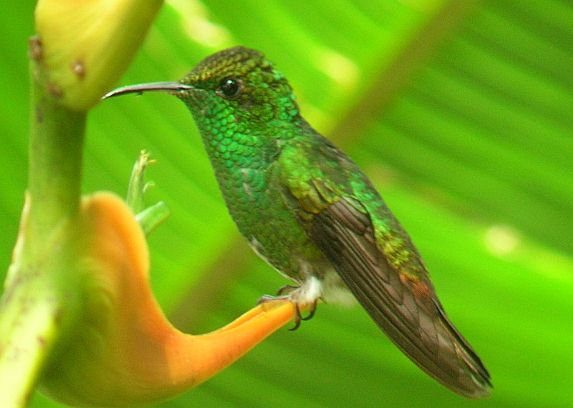
The hummingbird front has seen more Coppery-headed Emeralds but still seemed somewhat slow. To make up for it, on a recent trip, we had a few more species at the Soda Orquideas just up the road.

The birding is also quality in the general vicinity of Cinchona. For example, while birding around “Old Cinchona” and from Soda Orquideas, we had one distant Ornate Hawk-Eagle in flight and the same or another perched as well as Barred Hawk, Bat Falcon, Short-tailed Hawks, White Hawk, and Swallow-tailed Kites.

Migrant Birds Moving through Costa Rica

Last but not least, coming back to migrants, shorebirds are moving through Costa Rica in fair numbers and the first of others have arrived. Those include Orchard Oriole, L. Waterthrush, migrating kites, and a surprise Yellow-throated Warbler (!). Soon, we should also be seeing Yellow Warblers, Ceruleans, and some other birds.

Later on, I worry we won’t see as many Tennessee’s, Swainson’s, Red-eyed Vireos, and some other species. I hope so but worry they aren’t faring well with the massive fires on sizable parts of their breeding grounds. We’ll get an idea about that in September and October.

To learn more about sites mentioned above and hundreds of other Costa Rica birding sites, please consider supporting this blog by purchasing “How to See, Find, and Identify Birds in Costa Rica”. I hope to see you here in Birdlandia!

Categories
bird finding in Costa Rica Birding Costa Rica seawatching

Seawatching from Puntarenas, June 14, 2026

Birding is more than watching birds. Anyone who has partaken becomes aware of this fact, probably after the first time they do it. Speaking of birding for the first time, I don’t recall having a definitive first birding moment or excursion or class. However, there was that time when i was six when my father brought me to Canada, maybe to cheer me up, and that might count. I had a minor infection on my left index finger, had to have it lanced, and recall him taking me to Canada not long after.

By “Canada”, I mean walking across the Rainbow Bridge to visit the same named city of my home, on the other side of the gorge, Niagara Falls, Ontario. From my parent’s house just off Pine Avenue in downtown Niagara Falls, NY, it took around 15 to 20 minutes to walk to the bridge. That close and yes, we could hear the Cataracts of Niagara at our house, if quietly, off in the distance, 24/7.

I don’t exactly recall walking across the Rainbow Bridge, maybe because I eventually ended up doing that dozens of times, nor do I recall when we had our adventurous stroll (for a 6 year old) but, I do remember two things from that day in 1977, quite clearly. The first is when we spoke with the Canadian border agents. Noticing my bandaged finger and being a good sport, one of them asked me if I was a fighter. I must have said no, I think they laughed and he replied, “That’s good because we don’t let fighters into Canada”.

After they let me in on account of being an injured non-fighter, my father and I walked through the beautiful parklands that paralleled the rim of the gorge. This is some of the area that offers spectacular views of the American and Horseshoe (or Canadian) Falls. It can also offer magical, look-down views of a myriad of gulls, loons, and other river bird life but I wasn’t aware of that at 6. The park has big, old trees, flowering bushes, and other beautiful garden greenery. There’s also birds, mostly common ones, and one of those birds is the other main thing I recall. I noticed a striking male Red-winged Blackbird foraging in the grass and I asked my Dad of he knew what that bird was. He said he did not but wondered if it might be an oriole.

Not a bad guess for a non-birder, he did get the family right! I can’t say that was my spark bird; I was already interested in animals and became interested in birds by way of books at the Earl W. Bridges Public Library. I had also already been looking at birds and trees and other aspects of nature so, I can’t really say it was my first time doing some sort of birding either. However, that visit to Canada at six might have been the first time I specifically asked about the identity of a bird species.

In any case, if we did happen to refer to that day as “birding”, even if our main focus had been watching birds, it would have also been much more than that. There was positive interactions with border guards, strolling through beautiful green grass with my father, noticing the jade green waters of the Niagara River flowing 180 feet below, hearing tourists speak in languages other than English, and more. This being 1977, although I don’t recall, there must have also been boat-sized vehicles and quite the disco fashion scene going on.

In any case, what I’m saying is that birding is always more than watching birds and, we even have subsets of birding. Oh yes, we do since, although birding is checking out feeder birds while sipping hot ,fresh coffee (feedercoffeebirding?), it’s also creeping through rainforest to stalk antpittas, watching migrating raptors, and challenging winter’s bite to look at ducks.

Yesterday, my subset of birding involved staring through optics while slowly scanning back and forth, hoping to pick up movement while the sea breeze whistled in my ears. I was seawatching and doing it at Puntarenas, one of the better spots in Costa Rica to carry out this focused birding subset.

I had been eager to visit Puntarenas after hearing about El Nino birds in Panama. Those would be seabirds moving north from equatorial and Humboldt Current waters to look for better foraging grounds. Sadly, with water temperatures being pretty El Nino warm here too, I don’t know how much sanctuary they’ll find in Costa Rica. Nevertheless, the birds have arrived in Panama and some (or maybe many) will also make their way to these shores.

We’re talking birds like Blue-footed Boobies, perhaps a rare Peruvian Booby, and chances at other mega rare birds for Costa Rica. Maybe an Inca Tern? Could a Guanay Cormorant appear? What else? The only way to know is by looking for them and you can’t go wrong by watching from Puntarenas. You’ve got to watch from the area of the lighthouse and watch with a scope too but, you do that long enough, you should see something interesting. I suspect the avian prizes have something to do with the spot jutting into a meeting point of currents and where the inner gulf sort of meets the outer gulf.

Yesterday, I wasn’t sure what I’d find or, if there would even be any birds at all. Happily, there were and it was a good, productive morning of seawatching in Costa Rica.

The Usual Flybys

While scanning from Puntarenas, you’ll see the usual flybys, the birds to expect and enjoy and become familiar with to train yourself to pick out less common species.

I watched and saw Royal and Sandwich Terns both near and far, flying to and from the inner gulf. I checked every one and you have to because a juvenile Red-billed Tropicbird can look surprisingly like a Royal Tern and, although rare, they do visit the Gulf of Nicoya.

There are also the two big common bruisers, Brown Pelicans and Magnificent Frigatebirds while pairs of White Ibis oddly flap their way across the gulf. Laughing Gulls also fly past and you’ve got to watch them too, you don’t want to pass off some rare gull for a Laugher!

Keep scanning and you’ll probably pick up Neotropical Cormorants and one or two Cocos Boobies. That Sulid used to be commoner although it’s still regular, especially from the ferry.

Pelagic Birds!

Keep scanning back and forth, keep looking because, eventually, a tiny black bird might come zipping over the waves, like a bat out of the big blue abyss. I didn’t see any storm-petrels from shore yesterday but, I wouldn’t be surprised if a few were visible from the ferry. Consolation was welcome in the form of few Galapagos Shearwaters, way out there, fluttering low over the waves. Distant, but the only Puffinus shearwater at this time of year, and regular in the gulf, especially in the summer.

A Galapagos Shearwater from another day.

While scanning, I also picked up another pelagic bird, one I would have missed if I had ignored the distant terns. I picked up the long winged bird in the scope as it leisurely crossed over sizeable parts of the gulf and, seeing that it wasn’t exactly one of the usual flybys, stayed on it. Darker gray back and a hint of a head pattern, Bridled Tern! Now is a good time to see this elegant seabird in Costa Rica, especially from the ferry.

The other pelagic bird species I saw might not exactly fall into that category but I’ll mention it here anyways. While scanning, a few, smallish, fast flying birds caught my eye. “What are those?!” I wondered as they zipped to the right and joined a small feeding flock of regular terns. Darkish, they fluttered and I saw the white below. Of course, Black Terns! Not all move north, some stay in Costa Rican waters, all year long.

Blue-footed Boobies

Blue-footed Booby

Those distant pelagics weren’t the only fun birds on yesterday’s seawatching block. The stars of the Puntarenas birding show were much bigger and a few came quite close to shore. They were also one of the first birds I noticed, Sulids diving in the shallow waters of the inner gulf. Silhouetted, they could have been Cocos Boobies but when they flew into better light, they revealed their identities. Dark beak, white on the tail and a big white patch on the back, yes!, Blue-footed Boobies!

The El Nino birds were here and they showed very well with a couple floating in full view. I made a conservative estimate of 4 but am pretty sure there were more, way out there in the waters of the gulf.

Surprise Arctic Terns!

An Arctic Tern from another year.

Saving the best for last, I was sort of mindblown to witness a quartet of small terns fly into view. Like several other birds, they were flying towards the inner gulf, coming in from the deeper, wider waters and flying past the point. Not all that close but, close enough to catch some field marks through the scope.

Smallish and pale, I nearly cast them aside as distant Sandwich Terns. Luckily, I realized that ID didn’t quite fit, that although they had dark beaks, they weren’t that species. Flying quickly past, I saw pale wings with some of a dark carpal bar but didn’t notice any dark secondaries, didn’t see any dark on the topside of the primaries. Something wasn’t clicking, something didn’t make sense because those birds didn’t belong there right now, even when I got a clear, definitive view of the underside of the primaries. There it was, a narrow, dark line etched on the trailing side of the primaries, like someone took a fine-tipped permanent black marker and drew that unmistakable line, the one that an Arctic Tern shows.

It’s a shame I did not have a camera but I had seen enough, especially after reviewing dozens of images of June, immature terns. When I read that yes, many young Arctic and Common Terns spend their first summer on the wintering grounds, it made more sense. I can’t help but wonder if those young Arctics were El Nino birds too? I suspect so, I don’t think they’d normally have much business visiting the gulf at this time of year, much less Costa Rican waters in general but, there they were and I wonder, what the heck else is out there right now? Inca Tern? Kelp Gull? I wouldn’t be surprised, I need to take that ferry.

To learn more about birding Puntarenas and hundreds of other birding sites in Costa Rica, support this blog by purchasing my 900 plus page ebook, “How to See, Find, and Identify Birds in Costa Rica”. Happy birding however you do it, I hope to see you here!

Categories
big year bird finding in Costa Rica Birding Costa Rica birds to watch for in Costa Rica

Six Months Birding Costa Rica, 600 + Species

It’s June, 2026, do you know how many birds you’ve seen this year? Or heard? If you’re keeping track of the number of bird species you’ve identified, take note, 2026 is halfway over! Yep, 6 months down and 6 months to go and whether you are a birder doing a Big Year or just counting year birds, you’re about to enter the home stretch. It’s a long 6 months but they’ll go fast; time is running out!

The hour has arrived to plan out the next 6 months, to arrange trips and visits and birding breaks for the birds you still need to identify. Make plans and restrategize and mark calendar dates. Book hotels or check out campgrounds and maybe flights, it’s up to you to see how far you want to take your annual counting of birds.

Or, count but go the Zen birding route and take the birds as they fly. Meditate under an old growth tree to clear the mind and then go birding whenever and wherever. You won’t see as much as the red-eyed, strategists but so what? Mushroom tea and woodpecker drums? Watching soaring raptors and imagining what it would be like to ride those same thermals? This is your birding year, you can count birds however you want or, not even count them at all. It’s your birding list, this is your birding life.

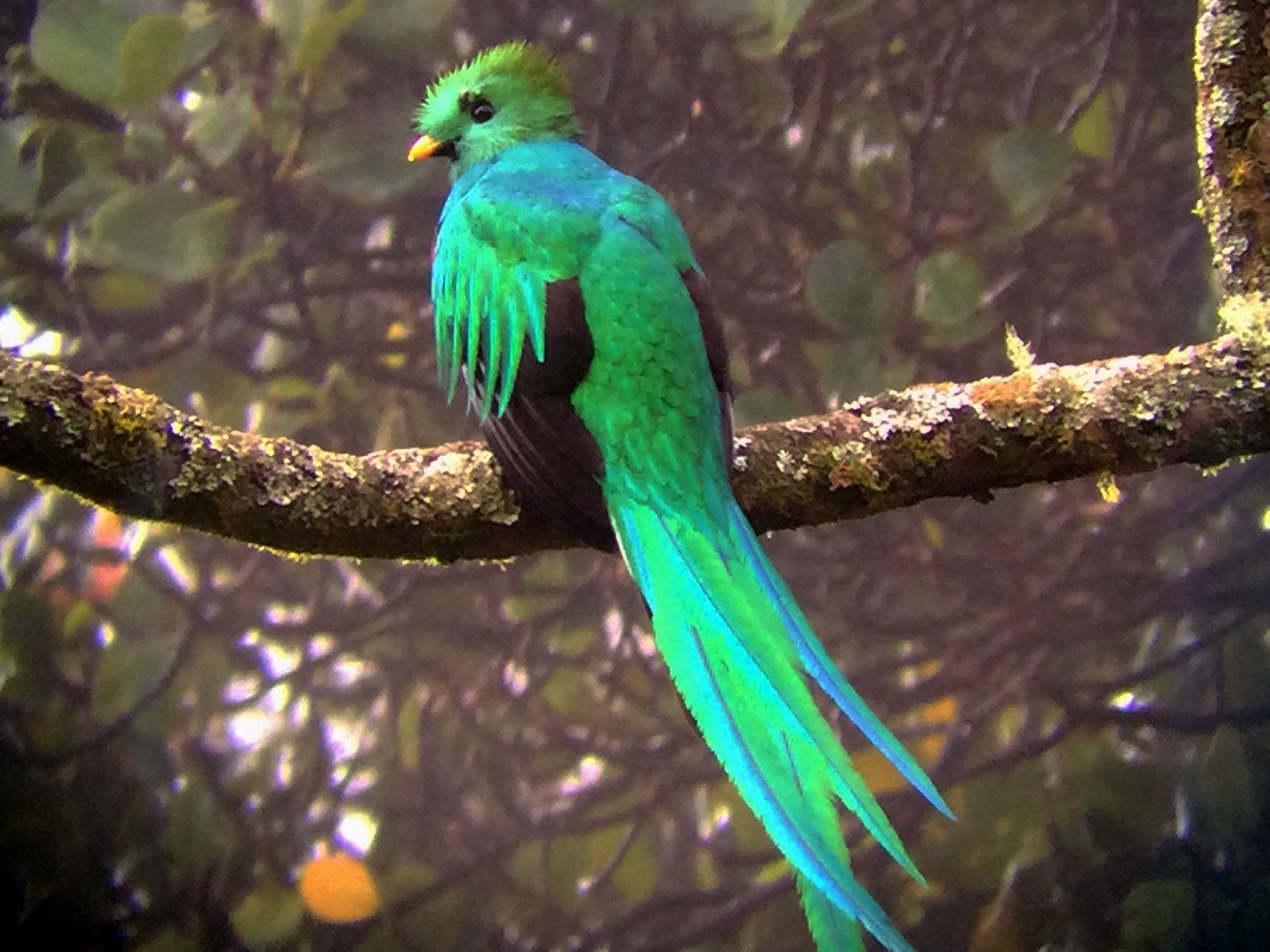
But you really should try to see a Black-and-yellow Tanager. Or a Swallow-tailed Kite or one of those blue-faced Black Guans or, gasp, the magnificence of a Resplendent Quetzal. As much as I dislike the pushy connotations associated with “should”, in this case, it’s all about making birding recommendations with the best of intentions.

We enjoy whatever birds we see but let’s face it, some birds sort of look pretty mind blowing more than other birds (hello House Wrens…). Take that aforementioned tanager for example. The male’s bright, nearly orange-tinged yellow contrasts with coal black and it has a slender look and beak that make it look sort of like a king warbler.

Or the kite in being a living definition of elegance. That raptor was built to mesmerize!

The guan is cool because yes, it does have a blue face and, that’s not all! It has garnet eyes that makes it look like an escapee from the stuffed animal dimension.

As for the quetzal, reasons to see that ridiculously extravagant bird are self explanatory. I mean, the thing is big, it shimmers better than cellophane (!), and makes wacky, cackling sounds in flight. If you have yet to see one, prepare thy mind for sensory birding overload. Tears may happen (and justifiably so).

A male quetzal is always the star of the avian show.

It’s June, 2026 and I’m pleased to have spent some time with these species since January. I hope to keep seeing them but, I do have some other birds I’d like to experience over the next six months. Those would be bird species I have yet to run into this year in Costa Rica, svelte birds like the Spotted Rail and Paint-billed Crake, Elegant Trogon and Ivory-billed Woodcreeper. Ruddy Woodcreeper would also be welcome along with Thicket Tinamou and Stub-tailed Spadebill (a right name for a truly gnomish little bird).

If I make it up to Guanacaste and bird Rincon de la Vieja and other right places, I should connect with these species and more. Looking at other blanks on my year list, it looks like several mornings of dawn chorus in quality middle elevation forest could also work out well. I do that and I’ll have a better chance of hearing rarities like Strong-billed and Black-banded Woodcreepers and maybe a Black and white Becard. I might also meet with Azure-hooded Jay, antthrushes, and other unseen year birds that reside in dripping, mossy cloud forest.

It’s no surprise that uncommon species from other bioregions are likewise lacking from my year list. Those would be birds like Tody Motmot, Black-eared Wood-Quail, and a few other denizens of the foothill zone, a handful of high elevation species, and some birds more likely in the South Caribbean.

However, the birds I need to truly push me over the year bird edge are a combination of migrants and seabirds. I don’t know if I’ll make it out to pelagic waters but, if I do, I can expect ten or more species, birds like storm-petrels and shearwaters, and the long-winged terns of the high seas. Luckily, I can also catch up with some of them from the ferry in the Gulf of Nicoya coupled with seawatching from Puntarenas.

As for my missing 2026 migrants, I’ll have to wait until September to look for various shorebirds and, then, go all out with year birding efforts in October. That translates to listening to night skies, going birding most mornings, and looking for migrants as much as possible, especially on the Caribbean coast. That’ll boost my chances at finding rarities for Costa Rica like some warblers and Least Flycatcher (yeah, it’s rare here!) but it’ll also be a treat to bear witness to all the kingbirds, swallows, raptors, and other birds moving south.

Even if I didn’t see any new year birds, it would still be all good. I can’t complain with identifying 604 year birds so far including key species like Red-fronted Parrotlet, several owls, Bare-necked Umbrellabird, Lovely Cotinga, and lots more!

I can’t complain with watching flybys of White-fronted Parrots and Red-billed Pigeons in an urban neighborhood either. There’s always lots to see in Costa Rica, go birding here and you won’t be disappointed!

In the meantime, I’ll do some strategizing, do some focused searches for missing year birds, and work on various writing and bird-related projects. One of those is updating “How to See, Find, and Identify Birds in Costa Rica”. Although this Costa Rica bird finding guide is fairly complete, there have still been a few new places to add and others to edit. Hopefully, I’ll be able to finish that update soon. Until then, happy birding, I hope to see you here!

Categories
Birding Costa Rica Global Big Day

Global Big Day, May 9, 2026, Costa Rica

I didn’t do much birding this weekend. Yes, there was the automatic birding that happens when Crimson-fronted Parakeets exclaim their presence from urban ledges, Clay-colored Thrushes sing outside, and Brown Jays call from a neighboring farm but, I did not specifically venture outside and look for birds. As eBird would say, my birding the past two days has been completely “incidental”.

I’ll tell you what though; I made up for it last weekend (Saturday in particular) and while guiding in the Poas area a few days later. On the 13th, we had 100 plus species while birding cloud and middle elevation forests near Poas Volcano. There were silky-flycatchers, Resplendent Quetzal, Flame-throated Warblers, a glimpsed Nightingale-Wren, eye-catching Swallow-tailed-Kites, and a whole lot more but, even that wealth of birds didn’t compare to the birding bonanza that took place on the 9th of May.

birding Costa Rica

That auspicious day was Global Big Day and, as befits such a bird-focused date, the birding was fierce, nonstop, trying, tiring, and simply glorious. I saw a lot but what makes Global Big Day especially fantastic is knowing that other birders from around the world are likewise focusing on birds; watching and listening and counting and noting and birdbathing in the magnificence of our feathered world.

On May 9th, 2026, those other birders celebrating the avian side of life included 81,000 plus people and although I only ran into a handful, I love knowing that all these other folks are also out there in Nebraska and Oaxaca and Japan and Tanzania and so many other places digging birds too. See some of their stories at the Global Big Day results page, and check out country and world totals at the main Global Big Day page. You’ll notice that, this year, us Global Big Dayers collectively identified more than 8,000 species! Here’s some of what happened in Costa Rica:

Good participation in Costa Rica

Although I only saw a few other birders, according to the Costa Rica results page, more than 1,000 birders were submitting lists on May 9th! That’s fantastic because, as with everywhere, the more birders the better. We also submitted a lot of checklists (more than 3,400), and had some major team results on the international stage.

In looking at the results, it looks like we had birders covering most corners of the country, including one or more pelagic trips off the Pacific Coast. Thanks to those boats, somewhat elusive birds like Christmas Shearwater and Tahiti Petrel made it onto the Costa Rica GBD list.

703 Species

Together, we identified more than 700 species, an excellent total given that a high proportion of migrants have already flown north. Some were still around, principally shorebirds, but overall, most birds on the GBD list are residents.

These included all regularly occurring hummingbird species, all tinamous, most woodcreepers, most cotingas, and so on. Of note were 37 species of diurnal raptors! That’s a good reminder that even though raptors in Costa Rica are generally uncommon, we have an impressive number of species and if you cover enough ground, you’ll end up seeing quite a few. The only regular one missing was the Pearl Kite.

Pearl Kites are uncommon, shrikeish, mini raptors.

Missing birds

Most of the resident species not recorded read like a typical wish list for folks who have birded Costa Rica on several occasions or, the rarities that tend not to be seen on a birding trip. These included challenging species like Masked Duck, Tawny-faced Quail, Violaceous Quail-Dove, Olive-backed Quail-Dove, White-tailed Nightjar, Buff-collared Nightjar, Ocellated Poorwill, Spot-fronted and White-chinned Swifts, Rufous Nightjar, Lanceolated Monklet, Great Jacamar, Slaty-backed Forest-Falcon, Spot-crowned Antvireo, Scaled and Black-crowned Antpittas, Black-banded and Strong-billed Woodcreepers, Lovely Cotinga, Gray-headed Piprites, and Botteri’s Sparrow.

These species are tough but still regular in the right places. On past GBDs, we’ve recorded all of them by having birders looking for them in key spots. This time, I think we just didn’t have that going on.

That especially rings true for species like Spotted Rail, Mangrove Rail, Brown Booby, Pearl Kite, Middle American and “Puntarenas” Screech-Owls. All of these are fairly expected when birding certain areas or sites (although I do wonder if the two species of screech-owls aren’t vocalizing these days).

The highest total for Costa Rica

It was a long day but I was pleased to get the highest non-team species total for Costa Rica (and one of the top ten totals on the global stage). 283 species in one day also shows how darn birdy Costa Rica is especially considering that we started at midnight (although 2 a.m. was still pretty early), detoured into the Central Valley, and had some breezy and hot conditions that limiting bird song.

As is often the case, some odd birds failed to show in places where I typically record them but, I also had lots of highlights. The rare and unexpected bird experiences included Least Bittern calling once from a brushy wetland near Orotina, hearing Harris’s Hawk call just before dawn, hearing a couple of late lingering Indigo Buntings, and having a few Uniform Crakes call to each other at the end of the day, just before the rains poured down.

Carara also worked out despite being hot and home to way too many cicadas. Back in the more humid part of the forest, the areas with the biggest trees and farthest from the road, I was treated to tough and iffy birds like Piping Long-tailed Woodcreeper, Green Shrike-Vireo, Black-striped Woodcreeper, Baird’s Trogon, and Scaly-throated Leaftosser.

This eye-smacking bird has become iffy at Carara.

My raptor day was pretty low but lots of other birds showed, especially at and near Carara, and in the Poas area. What’s kind of crazy is that I’m sure I would have identified even more if I had not detoured into the Central Valley and, if conditions were slightly better for bird activity. Not to mention, very few wintering birds were still present, if so, I probably would have broken 300.

It’s also worth mentioning that all these birds also happened while driving an electric vehicle and even stopping to charge it mid-morning (where we picked up Rock Pigeon ta da!). Regarding that, I’ll be writing more in detail about electric vehicles in Costa Rica as well as the Global Big Day experience in other places. In the meantime, I’ll just mention that my GBD, and the Costa Rica GBD totals in general remind again how incredibly birdy Costa Rica is.

To learn more about the Costa Rica birding sites mentioned above, you’ll find lots of information at this blog as well as in my 900 plus page ebook, “How to See, Find, and Identify Birds in Costa Rica“. I hope to see you here!
Categories
bird finding in Costa Rica Birding Costa Rica birds to watch for in Costa Rica

The Swifts are Back in Town

In Costa Rica, the dark clouds of the wet season have descended upon us. Every afternoon, around one or two, they gather and swoop in to unleash their million count buckets and if the winds happened to bring in a bit of extra moisture from the Caribbean, the sky loaders work double, triple time to keep the rains a coming.

It’s only May, the rain bringers are just getting started; barely kicking the gears to get that sky river rolling. Some afternoons, the rains deluge and flood streets, even create local tornadoes. We saw one such heavy energy system the other day, happily, from a safe and dry distance. It was a massive lead block, a thing of dense gray water seemingly turned solid and alien that grossly interrupted the usual bucolic scenery of towns, scattered palm trees, and green quilted hills. In the news later that day, we watched footage from the center of that aquatic creature, an ocean in action that ripped off roofing and forced trees to bend the knee. From our perspective, it was a lead void that obscured the skies over the town of Grecia and the southwest flank of Poas Volcano. From the inside, I figured I had learned what a fish sees when it looks through the water of its tank.

Fortunately, so far, that seemed to be the worst of the early wet season weather. No doubt, as the season moves forward, we’ll see more of the sky becoming oceanic, especially with a super el Nino forming. What will it bring? Probably nothing good, severity on top of extreme is never a boon, at least not unless you are a mountain hoping to shed tonnages of soil and trees. Not unless you are a stream dreaming of becoming a rushing, unstoppable river.

In the meantime, although we have seen a few afternoons of rain steady from the afternoon on well into the night, there have also been sunny mornings, fresh foliaged trees graced with singing vireos (a la Yellow-Green), Clay-colored Thrushes bring beakfulls of food to hidden young, curious, loudly calling Brown Jays, heavy set Red-billed Pigeons power flapping through the humid air, and other neighborhood urban birds.

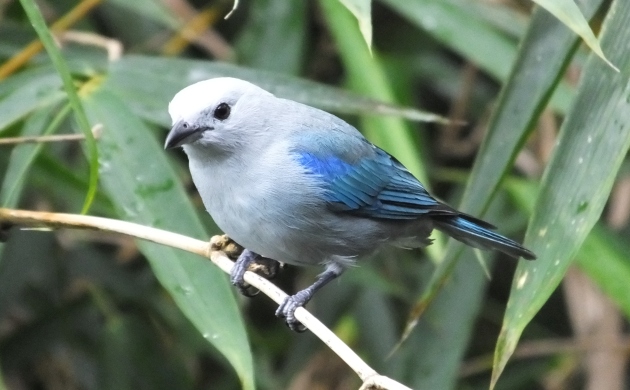
Those would be species like Blue-gray Tanagers, an occasional Blue Grosbeak warble-singing with hope at the edge of determined second growth, a motmot hooting from the shade, and others.

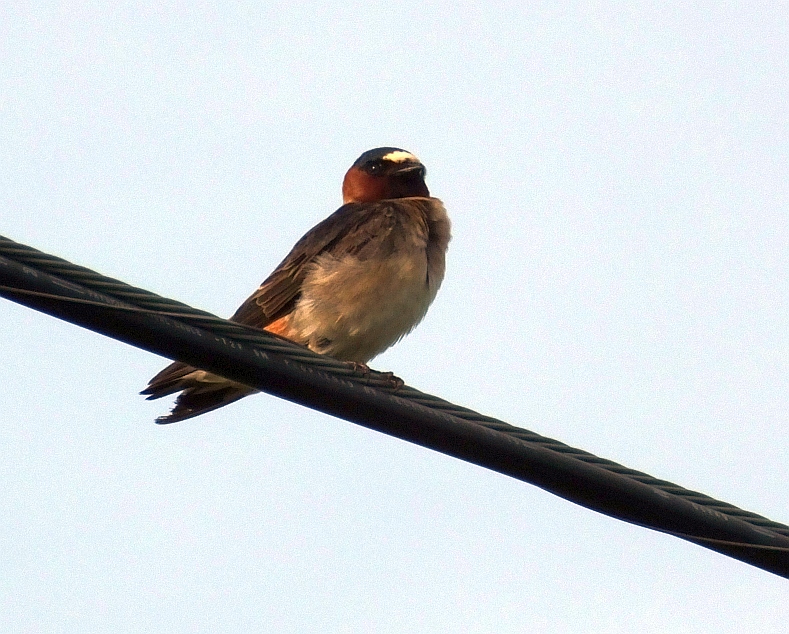
Here at the tail end of migration, as the warblers in NYC sing proud to announce their festive northern arrival, we still have some migrants. These are the classic “late ones”, the birds hesitant to leave their Amazonian haunts. Yesterday morning, around 5:40 a.m., I saw some of those later migrants; a flock of Eastern Kingbirds winging it north and briefly stopping to feed from a fruiting fig, pewees air bouncing from perches, and a stealthy Willow/Alder Flycatcher keeping to low vegetation at the edge of a small, urban stream.

My greatest hope is seeing a migrating cuckoo, the more likely one being a Yellow-billed. But they are tricky here in Costa Rica, with those long, svelte wings, most probably zip right over the entire country in one night. The ones that stop hide all too well and they don’t sing but I know they are here, hopefully I’ll get lucky before they are gone. I’ve been listening for them at night too but haven’t heard any. In fact, although I have heard various other species call from night skies above the Central Valley, I have yet to hear the guttural calls of migrating cuckoos.

I might not be seeing cuckoos but I’m grateful to see an abundance of swifts. It’s like this every wet season. After clear and breezy dry season skies nearly bereft of swifts, all of a sudden, we’ve got the air birds dotting the cloudy skies, calling from high above, and even zipping low over local roofs. They’ve come back to town and are still ever difficult to see well but at least they are here.

Where were they in the dry season? In all likelihood, the swifts were out foraging over rainforests or, maybe just too high overhead to see. In the dry season, birding eyes can always find the low flying Chaeturas (the good old “cigars with wings”) and the falconish, big White-collared Swifts but, to see the less common swifts, you usually need to bird more humid regions.

Not so right now and, amazingly, the uncommon swifts will forage right over busy streets and congested roads. That’s how it was this afternoon. While waiting in line for a late afternoon traffic light to change, dozens of scythe-winged, dark birds zipped over houses and busy streets. If anyone person bothered to look up and notice them, they could easily be envious. While we sat nearly trapped in vehicles waiting to move a few feet, the aerialists moved unhindered and fast, flying where they pleased and far, as if the town wasn’t there, as if to show off their natural freedom.

Without binoculars, I couldn’t say for sure which species were flying overhead but suspect they were mostly Chestnut-collared Swifts along with a few other species. When I got back home, birds were still flying over houses as well as high in the sky. Thanks to magnified views, I espied several White-collared Swifts along with a handful of Black Swifts, several Chestnut-collareds and, the stars of the wet season, Spot-fronted Swifts.

A few swift photos from some years ago…

There may have been White-chinned as well but I couldn’t see enough details to say for sure, nor did they reveal their identity with vocalizations. Happily, the Spot-fronteds did, mostly as they chased each other on air-chopping, bat-like wings. I suspect it’s some form of courtship, supposing they know that now is the time to nest, now is the time of insect abundance, at least on the Pacific side of the mountains.

We’ve been witness to that abundance ourselves, noticed clouds of gnats, millions of tiny bugs swarming over the streets. Swift and flycatcher food, could that also be why the flycatchers migrate late? More en-route sustenance?

The low pressure and clouds drive the air plankton down and the swifts follow suit. And you can actually see them, note pale scaling on the belly and eventually catch the fine details on their heads and, even so, their fast ways ensure that they aren’t the easiest of birds to watch. But now is the time to try and focus in on swifts in Costa Rica, at least in the Central Valley, because now is when the swifts are back in town.

To learn about swift identification in Costa Rica, check out the freshly updated Costa Rica Birds- field guide app, my ebook, “How to See, Find, and Identify Birds in Costa Rica” and this excellent article written by my friend and Ornis birding guide, Dani Lopez-Velasco, “Neotropical swifts: some noteworthy Peruvian records—and additional aerial enigmas“.

Categories
Birding Costa Rica birds to watch for in Costa Rica middle elevations preparing for your trip where to find birds in Costa Rica Where to Watch Birds in Costa Rica and How to See Them Book

Observations from Overcast Birding near Poas, Costa Rica

Going birding in Costa Rica? It’s worth being aware of the biggest birding factors. If you’re a birder, you already know them; factors like habitat, time of day, season, and weather. In these modern, tech-birding times, we can also factor in eBird although it’s worth mentioning that you can’t trust all eBird records and, that bird sightings are automatically biased for heavily birded areas.

That bias means that yes, you can get an idea of where certain species have been seen but, it doesn’t mean that they don’t also occur in other suitable places. Remember that there’s a lot of places with little to no eBird coverage, and even in places where folks do go birding, many aren’t finding all the birds in that given area.

I was reminded of all of these bird-affecting factors during a recent day of guiding in the forests on and near Poas Volcano. Since we couldn’t start until well after the early morning, I wondered what we would see. Would the day bring breezy, sunny weather perfect for picnics but bad for birding? Would we become besieged with pounding rain and be relegated to watching for a hint of avian life from a sheltered, fixed position?

As luck would have it, we experienced none of the above. Instead, we lucked out with the in-between weather, misty, cloudy conditions that do more than remind you of cool, camping weather in Pennsylvania. In Costa Rica, this is the weather you hope for because overcast days are always better birding days.

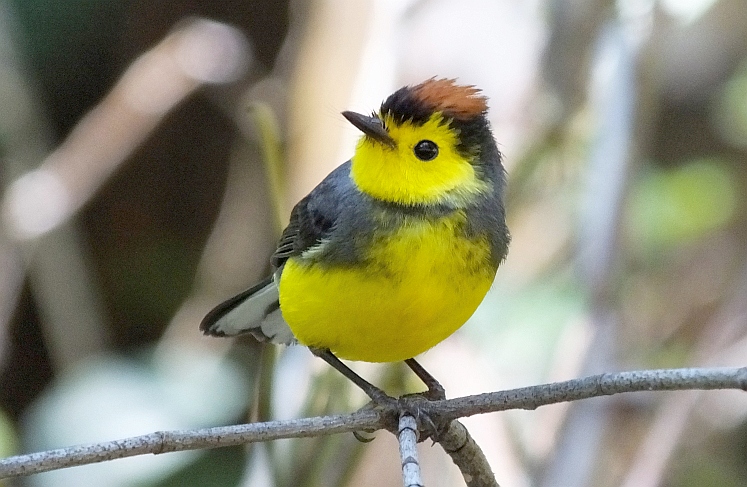
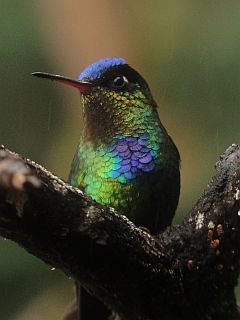
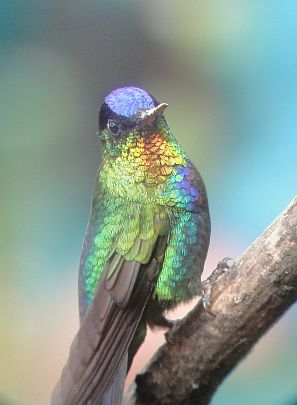
That doesn’t matter do much from 6 to 8 a.m. but after that avian morning rush, it makes all the difference. Arriving at the road to Poas around 11, we got there just in time for late morning activity. Under the cool, overcast skies, a good number of birds were active and calling and we were kept busy with nice views of regular resident species. Those would be birds like Collared Redstart, bush-tanagers, Mountain Elaenias, Slaty Flowerpiercers, Sooty Thrushes, Fiery-throated Hummingbirds, Mountain Thrushes, and others. Thankfully, those other species also included nest building Black-and-Yellow Silky-Flycatchers, and Long-tailed Silky-Flycatchers.

The Long-tailed in particular were in abundance, we had so many close views, we almost got tired of looking at them!

Other birds of note were a brief view of a Buffy Tuftedcheek, nightingale-thrushes, and a distant calling Buff-fronted Quail-Dove but I didn’t want to linger very long. There was a bit too much volcano traffic and we had other birds to see so, by noon, we made the short drive downhill for lunch at the Volcan Restaurant.

That nice, birder friendly site paid off with several hummingbirds and one of our birds for the day, Resplendent Quetzal! While watching from the back windows, in a surreal half a moment, we saw two quickly zip in and disappear in the streamside forest.

After failing to relocate them (but seeing Black-thighed Grosbeak in the process), I eventually spotted one of the males fluttering high over forest just down the road. As is usual with R Quetzals, it was another, dream-like surreal moment. While looking out over the forest, the bird suddenly appeared in silhouette against the pale gray sky. No colors, just a bird slowly flying in a straight line with its long tail fluttering behind it, all the while looking like a fancy kite being flown by a happy child.

We walked in that direction and sure enough, the male quetzal flew out again, eventually giving is excellent perched views joined by its mate.

The next place on our list were the cloud forests of Varablanca, forests that border Braulio Carrillo National Park between 1500 and 2,000 meters. We got there around 1:30 or so and it was still overcast but, the bird activity had calmed down quite a bit. That was surprising, it was early afternoon after all, about when many birds sort of take a siesta. Even so, in the high areas, we still managed to see Flame-throated Warblers, Barred Becard, and a few other birds before birding our way down the San Rafael Road.

Thankfully, this road is paved down to around 1550 meters as it borders beautiful cloud forest adjacent to Braulio Carrillo National Park. The good road condition and very little traffic always makes for fun, easy-going birding.

Although the cloudy conditions resulted in little soaring raptors, we did alright with some other birds. With diligence, as the afternoon wore on, bird activity eventually picked up again and we had views of Prong-billed Barbets, Northern Emerald Toucanet (that was actually early on at a fruiting tree), Tropical Parula, White-throated Spadebill, thrushes, woodcreepers, an extremely tame Collared Trogon, and some other birds.

One of those other birds beat out quetzal for bird of the day. Around 1500 meters elevation, while trying to espy a pair of skulking Red-faced Spinetails, a big, chunky, black bird fluttered into view. I immediately knew what it was and, thankfully, we for excellent views of a female Bare-necked Umbrellabird before it moved off and into the forest!

Not long before then, I had mentioned that umbrellabird was possible, that, given the time of year and elevation, a few were likely somewhere out there in those cloud forests. However, I also mentioned that we’d still be very lucky to see one. Running across one is typically random and there are few in number; it isn’t an endangered species for nothing.

I’m not sure why the umbrellabird was present but there were a couple of suitable fruiting trees near there and it’s possible it was feeding from them. Pale-vented and Mountain Thrushes were also foraging at those trees, heck, the even more elusive Lovely Cotinga might visit them too!

While we saw the umbrellabird, I also had another interesting observation. It was a sound actually and one that I still wonder about. It just doesn’t fit anything that could occur there, at least the bird vocalizations I am aware of. It sounded like a dove but the longish, descending call seemed too high pitched for a Ruddy or Chiriqui-Quail-Dove. Those are the two main candidates and I suspect it was one of them but I’d sure love to see what that bird was. I also wonder if it was some owl making some weird call during the day? All the more reason to return and look for it!

The final highlight was listening to nightjars at dusk. A bit after 6, Common Pauraques called and, in one spot, were joined by the whip-poor-willish sounds of the Dusky Nightjar. Listening to the evening nightjar serenade was a treat and a fine way to end our eventful day of birding.

To see the birds we recorded, check out the trip report. Learn more about these and hundreds of other birding sites in Costa Rica (along with how to find the birds) with my 900m plus page ebook, “How to See, Find, and Identify Birds in Costa Rica”.

I hope to see you here!

Categories
bird finding in Costa Rica Birding Costa Rica

Costa Rica Birding News April, 2026

April is the spring month, the one where the flowers come back to bloom, migrating Red-shouldered Hawks flap and turn high above the thawing grounds of the Lake Ontario plain, ducks are on the move, and Yellow-rumped Warblers brighten the local birding scene. Those and kinglets, and singing sparrows, and tail bobbing phoebes.

At least that’s how I recall birding on the Niagara Frontier, in the western edges of New York State. Birds are also on the move in Costa Rica but the scene is several layers of difference. Exciting layers of migration and local birds and a change in the weather. Here’s some news about some changes and what’s been happening and expectations for birding in Costa Rica this 4th month of 2026.

Cinchona…a lack of hummingbirds

Violet-Sabrewing-male
Even the sabrewings were absent.

The construction has been completed at Cinchona and it has brought more and needed elbow room. It probably hasn’t affected the surrounding habitat too much and birds still come to the fruit feeder but the hummingbird scene is at an all time low.

The lack of hummingbirds is probably at least partly related to the lack of feeders (just one was present on the last visit), but it seems like there should still be more. Maybe there’ll be days when they are more? Sadly, lately, there haven’t been so don’t be surprised if you visit and see very few hummingbirds. If not, don’t fret, you can still find them elsewhere, maybe at a few other roadside sites higher up the road and definitely at other places.

Watch the feeder and surrounding trees though. Highlights from a recent visit included Black-breasted Wood-Quail being furtive behind the feeders, and Scarlet-thighed Dacnis among other birds.

Hot weather but rains are starting

April is hot in Costa Rica but ends with fresh, rainy airs. Instead of that March lion start and lamb ending, we’ve got April beginning like a furnace and ending like a cool shower. Sort of. In any case, visit now and you’ll get hot days but you can also expect some cloudy weather and at least some afternoon rains.

Those rains and clouds are good for birding, get out there and watch, especially after the rain stops!

Swifts are in the air

One thing that the rains bring are swifts or, better to say that the rains bring the swifts lower and into view. The aerialists were always up there, just beyond speck visibility, up there riding the highest airs or chasing storms to Panama. Who knows?

What I can say is that with the rain clouds here now, you have a good chance of watching swifts within bino viewing range. Watch for them just before the storms arrive, right at the misty edge. It’s a good way to test your skills and patience trying to identify uncommon White-chinned and Spot-fronted Swifts. Hopefully they’ll call, that makes it easier.

Raptors flying too…

April is also raptor flying time in Costa Rica. In fall, the river of raptors flows south but, in spring, it reverses course and the flow gets a big pulse in April. The birds can fly anywhere (we saw a nice group of Swainson’s on Poas) but the Caribbean lowlands are typically best.

There be Broad-wingeds, Swainson’s, TVs, Mississippi Kites, and a few other birds. As The Urban Birder says, “Look Up”!

Ground-cuckoo may still be showing at San Luis Canopy

A Rufous-vented Ground-Cuckoo has been showing at an ant swarm near the San Luis Canopy for some weeks now. Since they are still seeing it, apparently, local guides keep track of ant swarms and can bring you to the bird!

Although that could change at any time, one of the local guides told me that they are still seeing it as of yesterday. To see it, inquire at the San Luis Canopy (opens at 8) and expect to pay $20 per person.

Big morning of birding on the Pacific coast- 226 species by 10 a.m.

On another nice and birdy note, my partner Maryllen and I started a Big Day a few days ago. Notice I only mention “started” meaning that we ended up aborting it pretty early. That was a shame but it had to be done; all the fast car chargers had stopped working overnight (and thus stranding several drivers) and since having them available was essential to the electric car Big Day plan, we had to abort the mission.

Nevertheless, we still had an exciting, successful morning of birding and the attempt helped me realize how I could tweak it to maybe break a record. Starting at midnight at Punta Morales and birding until 10 a.m. around Carara and Tarcoles, we identified 226 species. Yes, that many and mostly in the same area. That high number emphasizes how incredibly diverse the Carara ecotone is. For myself, it also helped me realize that, given the right factors on the rest of the route, reaching 350 or even 400 species is possible in one day of birding in Costa Rica.

Check out the trip report.

I’ll be writing more about this exciting day and idea perhaps here and elsewhere, stay tuned!

Third Edition of the Garrigues and Dean Field Guide Coming Soon!

It’s official, the third edition of the Birds of Costa Rica: A Field Guide is coming out! It’ll be available in October and, based on what I’ve seen will be yet another boon for birding in Costa Rica. The authors and publisher redid many illustrations, added various behavioral and habitat illustrations, and have included all species on the Costa Rica list.

If you are headed to Costa Rica after September, you’ll want to definitely get this book for the trip.

The Costa Rica Birds Field Guide app– customizable, updated with more bird finding tips, shows 1020 plus species.

If you’d also like to have a birding app to boost your birding experience in Costa Rica (and have an Apple device), this is the one to get. I admit I work on this app but that’s also why I know why it’s such a helpful tool before, during, and after a birding trip or tour to Costa Rica.

For the recent update, I went through every one of the 1020 plus species to refine their descriptions, habitat information, and tips for seeing them. I also included more birds, images and a vocalization or two. Why more birds? Since you can fit a heck of a lot in a digital format, I figured it would also be worth including species that could occur in Costa Rica. Those would be birds like Altamira Oriole, Yellowish Pipit, some Siberian vagrants, and various pelagic species.

Sure, a birder can download the Merlin pack for free but with this app, you can make target lists, mark birds seen and heard, take notes, look at species while listening to their vocalizations, and have more accurate, updated, locally written information and tips (along with other perks).

I could say more but I’ll leave the local birding news at that for now. If you’re headed to Costa Rica soon, I hope you enjoy your trip!

To support this blog and learn about 100s of birding sites in Costa Rica, ID tips, and more, please consider purchasing my 900 plus page ebook, “How to See, Find, and Identify Birds in Costa Rica”. I hope to see you here!
Categories
bird finding in Costa Rica Birding Costa Rica birds to watch for in Costa Rica Costa Rica birding hotels

A Productive Morning of Birding at Villa San Ignacio

Costa Rica can be a crowded place, especially in the Central Valley. While San Jose is technically only in one part of the valley, that’s how most visitors refer to this ever popular region. It’s not the only city or town in the Central Valley but no one can blame them for calling all of the urban sprawl and winding streets and small stores and quaint churches with shaded parks “San Jose”.

From a bit east of San Jose on west to the edge of Alajuela (that’s the actual name of the city where the airport is), it all seems to blend together. At one point in time, it certainly didn’t but we could say the same about Los Angeles, Dallas, Bangkok, and so many other modern mega-cities.

The Greater Metropolitan Area or (GAM as it is locally referred to) hosts a fair portion of Costa Rica’s 5 million people population and yet, birds are there too. Not as many as are even marginally wilder areas but in the GAM’s parks and riparian zones, urban birds persist. There are Crimson-fronted Parakeets roosting on and screeching from buildings, Blue-gray Tanagers and Great Kiskadees calling from parks and other birds too, more than you think.

However, species numbers really jump when you finally reach a good amount of green space, especially when you can bird in fair bits of remnant forest and other habitats. You’ll find those habitats in Estes Park as well as other Costa Rica birding sites shortly after leaving the edge of the main urbanized front. One such bit of green space is at Villa San Ignacio, a small hotel situated at the edge of the urban perimeter, just northwest of Alajuela.

Villa San Ignacio is a bastion for birds because although the hotel does have some landscaped grounds, it’s done in a manner that preserves and showcases biodiversity. Unlike so many other places, this hotel also hosts several large and mature trees, especially massive figs that provide critical food for a wide variety of species.

You can also check out short and easy trails in regenerating forest and watch the skies for flyover raptors, swifts, and other birds. Some road noise reminds you that you’re still in an urban area but the wealth of birds seems to convince you otherwise or, at least show what mature trees and habitat preservation does for birds, butterflies, and more.

On Monday, I spent most of a morning at Villa San Ignacio and the birding was good as always. As per usual, it was also unpredictable with some birds appearing and others staying hidden or being no-shows. That’s normal for tropical birding, at least in Costa Rica. It’s why it’s worth staying longer and birding the same rich areas more than once, why it’s worth always watching and keeping an eye out for the unexpected.

These are some of the highlights and happenings from that morning.

Cabanis’s Ground-Sparrow

Right off the bat, we hit the local jackpot with this rare and threatened species. Shortly after 6, while walking up the road towards the upper rooms, I was happily surprised to hear the high pitched tick of this special bird.

Even better, the pair and what looked like a juvenile foraged right in the open. They didn’t stray far from the hedgerow at the edge of a green, metal fence but you can’t ask much more from these major skulkers. As is typical for this special towhee, you’ve got to see it early and get onto it quick. It won’t take long for them to get into cover and be essentially invisible for most of the day.

Short-tailed Hawks and other Raptors

Around 9, as the cicadas pumped up the volume and heat waves swirled into the tropical skies, raptors did their morning dance. Black Vultures circled and gained height, a couple of migrant or wintering Broad-winged Hawks followed suit and were followed by high flying views of Gray and Short-tailed Hawks.

No Zone-tailed that day but later on, we also had both caracaras and additional Gray Hawks. It’s worth it to keep watching above, to keep looking up (as the Urban Birder David Lindo reminds us). Other days I’ve also seen migrating Swallow-tailed Kite and Swainson’s Hawk, Peregrine Falcon, and even Double-toothed Kite.

Long-tailed Manakin and other forest birds

Down in the forest, fewer birds showed than I had hoped but we still heard and saw some things. One or two Long-tailed Manakins called, “Toledo” while White-eared Ground-Sparrows gave cascading calls from the undergrowth and Rufous and white and Rufous-breasted Wrens dueted from the vines.

Those birds stayed hidden but we did manage to see Common Squirrel Cuckoo, Olive Sparrow, saltators, Cabanis’s Wren, Barred Antshrike, Gray-headed Chachalaca, and some other species.

Indigo Buntings

One of those species,, one of those surprises, was the Indigo Bunting. Not just one either but several! An uncommon bird in Costa Rica, it was fun to see fully plumaged deep blue males, molting patchy blue males, and at least one plain sparrowish female.

We probably had 10 in total, they were either migrating through or grouping together and getting ready to migrate. One also sang its prolonged, jumbly song that we hear at this time of year in Costa Rica. I included this vocalization on the recently updated Costa Rica Birds – Field Guide app but, in checking it, I realized that I also need to include the bunting’s commonly heard call notes. I’ll probably get to that in May but hopefully sooner (I recently included better habitat information, more birding tips, and images).

Speaking of buntings, on that morning at Villa San Ignacio, I was reminded that Painted Buntings can make a call that sounds a lot like the one-noted call of a Mourning Warbler (at least to my ears). While pishing by a hedgerow, a bird responded and I figured it would be a Mourning. Much to my surprise, I found myself focusing on a leafy green female Painted Bunting! It was a good reminder to brush up on their calls.

Plain-capped Starthroat and 69 other bird species

How many bird species can you see in a day at Villa San Ignacio? I figure that varies but I can say that 70 in a morning is possible. That’s what we had on Monday and that was also lacking several regular species! Some of the other nice ones were Plain-capped Starthroat on the walk up to the upper rooms, close Cinnamon Hummingbird, Scrub and Yellow-throated Euphonias, and a bunch of other birds, many feasting on the fruiting figs.

Check out the bird list!

That constant birding activity is why I always look forward to birding back at Villa San Ignacio. Along with the good service, friendly vibe, and beautiful habitat, it’s a hard blend to beat.

Categories
bird finding in Costa Rica Birding Costa Rica

Costa Rica Birding News- The Poas Area

Headed to Costa Rica? Wonder where to go birding in Costa Rica? You are the fortunate one. The cold fronts seem to have dissipated and they’ve taken their saturating weather with them. I don’t mean to speak ill of the rains, the complex tropical habitats in Costa Rica depend on their abundance and all the humidity they bring. However, constant wind and rain can become a bit too abundant, especially when the overexcited elements raise rivers and tease bits of mountains to race downslope and block roads.

For the moment, happily, those challenges seem to be taking a break. As a bonus, both lanes are also open on the Tarcoles Bridge! You could still run into traffic but shouldn’t have to deal with 3 hour traffic jams. You’ll probably still have to deal with some roadwork traffic between Tarcoles and Jaco but, it won’t measure up to the infamous bridge traffic of early March, 2026!

Better weather and less traffic jams (in some places) aren’t the only things to smile about. We’re birding up in here and the avian action is getting fierce! Birds seem to be tuning up in anticipation of the breeding season, I’ve seen several species with nesting material, and at least some areas seem to have a healthy variety of fruiting and flowering trees.

That of course translates to insect and bird food; exactly what we want. Much of what I’m saying stems from recent birding in the Poas area, check it out:

Resplendent Quetzal Activity

As is per usual at this time of year, quetzals are getting feisty. Actually, they’ve been feisty for a month or more but now, as they nest, they may call a bit more. At least that’s how it seems to me. In the Poas area (meaning anywhere from Poas to Varablanca and on down to Virgen del Socorro), I’ve heard quetzals singing and seen males give display flights. Not a huge number but, certainly more than other days.

Also, I’ve noticed at least a few trees covered in the small “wild avocados” that quetzals feed on (along with Black Guans and other fun birdies). There’s one within good viewing distance of a road and I’m guessing that one will be ripe for quetzal banquets in a week (and they might already be feeding from it!).

Lovely Cotinga Still Occurs in Virgen del Socorro

Whoah! Yep. Yes, Virgen del Socorro (and Cinchona) are in range for this uber stunning, rare bird but, they are rarely seen in that area. I figure the paucity of cotinga sightings from this classic birding site are related to the bird’s quiet nature, lack of spots to scan the forest canopy, and the species being genuinely scarce in Costa Rica.

It’s one of those birds that I figure could show up but, at the same time, wonder how many are still around, or, if they only occur far off on the other side of the canyon. After this past Friday, I’m pleased to say they can still show in the Virgen del Socorro area. We were checking the road between Socorro and Cinchona when I noticed the tell tale rustling of foliage that hints at bird activity. After a closer look, we realized that several birds were indeed feeding on berries; birds like Pale-vented Thrushes, tityras, elaenias, and others (although less tanagers than I had expected).

Given the quantity of fruit, I was also surprised to not see any toucans or guans. Would those diehard fruit lovers visit the natural table another time? Were they in another part of the forest? There did seem to be a lot of fruiting trees around. No matter how surprised I may have been by toucan absence, that didn’t come close to matching my smiling surprise at seeing a male Lovely Cotinga!

Amazingly, despite intently watching the fruiting trees, we wouldn’t have even seen it if I hadn’t decided to walk 20 feet up the road to check some other trees. As we walked underneath what was probably a fruiting fig, there was a big flash of turquoise, way too much for a male Scarlet-thighed Dacnis, and I immediately realized what was going down! No distant scope views that day. More like point blank, in your face looks at a shining, living turquoise sculpture with amethyst highlights.

After a couple minutes, the royal rare denizen of Socorro flew across the road and down into the canyon. You can bet I’m going to find some good overlooks for scoping the treetops. There be cotingas out there.

Cinchona Hummingbird Cafe- a Lot more Elbow Room

Over at the Cinchona hummingbird cafe, they have finished their remodeling. Alas, the rustic look is gone but so is the floor that sometimes shook with people’s footsteps. It has been replaced with a rock solid concrete base under a high roof. There’s a lot more elbow room and the place did need it but, it remains to be seen how that may affect the birds.

There’s a bit less habitat but, during a couple brief visits, the birding seemed alright. The usual suspects were still coming to the fruit feeder and nearby trees hosted some other species. Hummingbirds were not in abundance but, sadly, it’s been like that at Cinchona for at least a few months now. Wait long enough and maybe some will pop in for a visit but, lately, it’s mostly been the domain of Green-crowned Brilliants and a couple sabrewings.

Hopefully, that will change but I wouldn’t absolutely count on it. Instead, watch for hummingbirds at flowering plants and visit other sites.

Fair Hummingbird Action

This subtitle may seen contradictory to the text above it but yes, there has still been a fair bit of hummingbird action, just not at the Cinchona feeders. Are there more flowering plants in the wild, more hummingbird food available? Could be, I do know I’ve done alright with seeing a fair number of species.

In the Varablanca area, I’ve had good looks at Green-fronted Lancebill, Coppery-headed Emerald, Black-bellied Hummingbird, Green Hermit, Violet Sabrewing, Purple-throated Mountain-gem, Green-crowned Lancebill, and Scintillant Hummingbird.

Coppery-headed Emerald birding Costa Rica

Higher up on Poas, I’ve also had the usuals; Volcano Hummingbird, Lesser Violetear, Talamanca Hummingbird, and Fiery-throated Hummingbird. One spot has also been good for the woodstar and, down in the foothills, I’ve had good looks at Purple-crowned Fairy, Black-crested Coquette, and Violet-headed Hummingbird. I’ve also been hearing Brown Violetear. In other words, the hummingbirds are out there, you just have to know where to look (and have them show up).

Ornate Hawk-Eagles and Other Raptors

The sunny weather has also been good for raptors in the Poas area. Perhaps not so much in the high elevations but the middle elevations and foothills have delivered. I wish I could say Solitary Eagle but no, if that species still occurs in Costa Rica, there are likely very few in very remote areas.

However, I can say that I’ve been seeing several other raptors, especially Ornate Hawk-Eagle. The powerful goshawk on steroids can occur anywhere from Varablanca down to San Miguel, maybe even high up on Poas. Keep that mind when birding the area, even at Cinchona. Once, I saw one soar into view right next to the cafe.

Other raptors have included Barred, Short-tailed, Gray, Roadside, and Broad-winged Hawks along with King Vulture (near San Miguel), Double-toothed Kite, the rufous bellied local version of the Red-tailed Hawk, Swallow-tailed Kites, and the decidedly uncommon Great Black-Hawk.

And that’s not all! Although I have not seen them lately, White Hawk and a few other raptors also live in the general Poas birding area.

I suppose that’s all for now. Let’s just say that the birding has been pretty good up there and since it’s only 45 minutes to an hour drive from the Central Valley, a morning of birding could be well worth your while. Happy birding, I hope to see you here!
Categories
bird finding in Costa Rica Birding Costa Rica Pacific slope

Recent Birding News and Tips from Carara, Costa Rica

Last week, I did some birding around Central America’s biggest ecotone. It’s an area where rainforest meets dry forest meets mangroves and some! It’s such a crossroads of biomes and habitats, I’m not even sure if ecotone is the right term. “Megatone” might be better but “hot birding wonderland” would also work. I’m talking about Carara, the place where the Grand Tarcoles River empties the waters of the Central Valley into the Pacific, where coastal hills capture life giving rains, and where the biodiversity is sort of astonishing.

Given the meeting of so many habitats, the high end species numbers shouldn’t be surprising but, there’s just so much, I can’t help but use superlatives. If you’re headed to the Carara area, get ready for deserved superlative birding. Going birding around there soon? You might find these bits of news and tips helpful.

Tarcoles Bridge Work

Lately, this has been some of the biggest news in Costa Rica. The Tarcoles Bridge, the one where so many thousands of tourists stop to look at crocodiles, is undergoing roadwork. And it’s not pretty. Temporary road closures and changing the two lane bridge to one lane for 24 hours a day on the main and almost only coastal route to Jaco has its consequences.

I was there on the first day of the closures and on the way back from Jaco to Tarcoles, the normally 30 minute drive took four hours.

Yes, you read that right. Four. Complete. Hours. Since then, it’s been similarly bad, sometimes better, sometimes worse. Given that this is also a vital route for commerce, workers, and students, this particular bit of roadwork is throwing a giant wrench into a lot of people’s lives.

With almost no alternatives, if you are headed to and from Jaco or even Manual Antonio, you may be in for a terribly long wait. I suggest trying to see which times are best and probably crossing the bridge at 4 in the morning or so. The current schedule is for the one lane closures to end on March 27th and to happen again from May 4th to May 9th. There will also be some nighttime full closures from March 15 to April 20th. These can happen on any night during those dates from 9 pm to 5 am.

If you plan on visiting Carara National Park, the wait might be a bit less but anything can happen, perhaps more so on weekends. The good thing is that the park is fairly close to the bridge so, if you have to cross back over to the Tarcoles Birding Lodge area, that won’t take as long as driving from Jaco. I suppose another good thing is watching birds while you wait in traffic but, that’s not exactly ideal.

Yellow-billed Cotingas from the Tarcoles Birding Lodge

Now for some good news! While watching from the overlook at the Tarcoles Birding Lodge, I had a quick, distant flyby cotinga one morning and saw two distant males the following morning! This is great news because the Carara population is so dreadfully small, it really could disappear at any time.
Seriously, there might be 5 or fewer birds still occurring in the area. Another positive sign was a recent sighting of a female by an experienced ornithologist (which makes me think he really did see one and not a tityra). What this means for birders visiting the area soon is that you might also see one by scanning for them from the Tarcoles Birding Lodge in the early morning. You’ll see other birds too, maybe even a Gray-headed Kite like the bird pictured at the top of the post (we had one).

You might also get lucky on the Cerro Lodge road, boat tour, or even in the national park but your best bet will be scanning the distant mangroves from the Tarcoles Birding Lodge or maybe Cerro Lodge too or, maybe even another new place…

More Birdy Accommodation in the Area

The new place that could turn up the cotingas as well as lots of other nice birds is a cozy BnB called “Finca Quietud”. This small place just down the Cerro Lodge road is especially suited for couples and single travelers looking for a quiet place with friendly owners, an excellent breakfast, and a nice pool.

It also has an excellent view of a wetland, mangroves, and the sea. I bet the cotingas could be seen from there along with lots of other, more expected species. On a recent visit, one of our highlights was a pair of Spectacled Owls that flew into view before dusk!

Humid Forest Species in Carara

birding Costa Rica

Regarding Carara National Park and vicinity, it seems like the trend of humid forest species becoming rarer is taking place. Unfortunately, climate change has been causing the forest to become drier bit by bit or, at least changing the amount and timing of rains. In any case, various rainforest species seem to have declined and a few have become downright rare, at least in the accessible part of the park.

You can still see a good variety of birds but many are not as common as they used to be and a few have become really tough. The more challenging ones seem to be species that require the wetter forests, birds like Baird’s Trogon (maybe the hardest hit), Orange-collared Manakin, and Golden-naped Woodpecker among some others.

Carara is still worth birding but, to see some birds, if you aren’t birding further south, you may need to look for them higher up on the Bijagual Road or, at Macaw Lodge. It tends to be wetter in those spots (in a good way for birding) but, even there, Baird’s Trogon has become much less common. To look for those birds, especially at Macaw Lodge, local guide Beto Guido is one of the better guides to go with. He birds there quite a bit and recently, even found a rare Agami Heron at the lodge!

Mangrove birding

One of the other birding bonuses around Carara is looking for mangrove species. In Costa Rica, some of those specialties include the endangered Mangrove Hummingbird, Panama Flycatcher, and Mangrove Vireo among a few others. You might get lucky with those species on a mangrove boat trip but even then, they can be easily missed.

The funny thing about those mangrove birds is that they don’t seem to be very common, even in the mangroves! Usually, mangrove sites near Playa Azul are good for them but, recently, despite giving those sites a very good check, they weren’t.

Mangrove specialties seemed oddly absent there and at another spot near Bajamar. One thing I did notice was that those unbirdy mangroves also seemed drier than usual and lacked standing water. I suspect that has something to do with it because it was the only difference compared to past visits that did readily turn up the mangrove specialties.

Also, on a recent visit to mangroves at Mata de Limon, I did see all the mangrove specialties (and heard a Rufous-necked Wood-Rail too!) and those mangroves had lots of standing water. This was a change from another fairly recent visit where they were drier (and turned up far fewer mangrove birds).

I suppose the lesson here is to lower expectations or check other sites if the mangroves look dry and, maybe take that boat trip after all.

That’s all for now, if you visit the Carara area, I hope you catch the bridge traffic at the right moment and see lots of birds. Be ready for hot weather and bring plenty of hydration (no plastic bottles allowed in the national park). As always, I look forward to getting back to that birdy megatone.

On another note, I recently updated the Costa Rica Birds Field Guide app to match most of the recent eBird taxonomic changes and made some other changes too. I’ll write a post about that this upcoming week!

To learn more about sites mentioned in this post along with 100s of other birding sites and information about birding in Costa Rica, support this blog by purchasing my 900 plus page Costa Rica bird finding ebook, “How to See, Find, and Identify Birds in Costa Rica”. Happy birding, I hope to see you here!